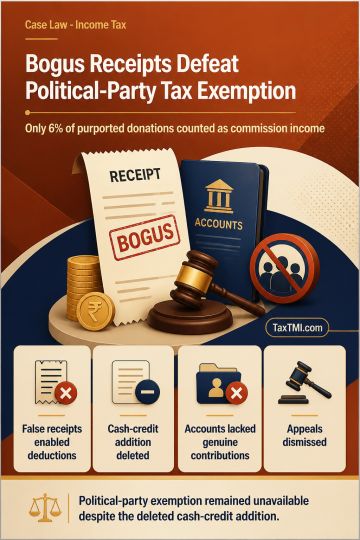
Bogus donation receipts justified commission income assessment and defeated political-party tax exemption for inaccurate accounts and reporting failur...
Pure reimbursement without income element escapes tax withholding, while delayed withholding and unsupported provisions face deferred or renewed scrut...
Public benefit requirement defeats charitable registration where residents' association services are reciprocal, member-only facilities governed by mu...
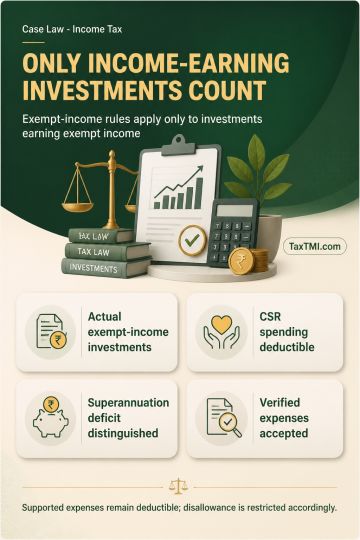
Exempt-income expenditure disallowance is confined to investments that actually generated exempt income, while supported business expenses remain dedu...
Objective characteristics and principal use govern mining-tyre classification, while fresh advance ruling applications may rely on additional technica...
Page of 4788
Press 'Enter' after typing page number.
461 to 480 of 95752 Results
❮
❯
❯❯
0 / 200
Expand Note
Add to Folder
No Folders have been created
+
Are you sure you want to delete "My most important" ?
In the ITAT Delhi case, the issue revolved around claiming exemption u/s 54F for investment in a residential house. The CIT(A) allowed the exemption based on the purchase of a property referred to as "Makan." However, investigations revealed the investment was in urban agricultural land used for a concrete brick manufacturing unit, not a residential house. The stamp duty and lease deed also indicated non-residential use. The tribunal emphasized the requirement of reinvesting in a new residential property for u/s 54F exemption, aiming to promote home ownership and economic growth. As no proof of a residential house was established, the claim was denied, holding the land with a shed as non-residential. The decision favored the revenue authorities.
In the ITAT Delhi case, the issue revolved around claiming exemption u/s 54F for investment in a residential house. The CIT(A) allowed the exemption based on the purchase of a property referred to as "Makan." However, investigations revealed the investment was in urban agricultural land used for a concrete brick manufacturing unit, not a residential house. The stamp duty and lease deed also indicated non-residential use. The tribunal emphasized the requirement of reinvesting in a new residential property for u/s 54F exemption, aiming to promote home ownership and economic growth. As no proof of a residential house was established, the claim was denied, holding the land with a shed as non-residential. The decision favored the revenue authorities.
Note: It is a system-generated summary and is for quick reference only.
 TaxTMI
 of 4788














 Join Channel


 TaxTMI