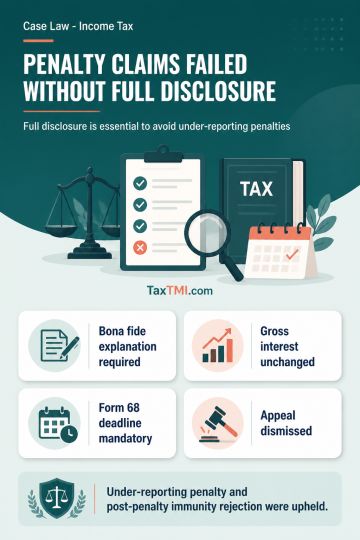
Bona fide disclosure requirements govern under-reporting penalties, and post-penalty immunity applications cannot secure available statutory protectio...
Certificate-of-origin verification procedure governs preferential customs benefits; denial without retroactive verification was set aside with consequ...
Disciplinary Committee jurisdiction and mandatory investigation requirements invalidated cancellation of an insolvency professional's registration and...
The ITAT Surat held that the penalty u/s 271(1)(c) was not sustainable due to a defective notice and estimation of income on bogus purchases. The notice u/s 274 was issued mechanically without specifying whether the penalty was for 'Concealment of income' or 'furnishing inaccurate particulars of income'. The additions were based on estimation without a definite finding on the quantum of concealment, rendering the penalty unsustainable. Legal precedent from the jurisdictional High Court supported this decision, citing cases such as CIT vs. Subhas Trading Co., Navjivan Oil Mills, and Valimkbhai H. Patel. Therefore, the penalty u/s 271(1)(c) was deemed not sustainable in this case.
The ITAT Surat held that the penalty u/s 271(1)(c) was not sustainable due to a defective notice and estimation of income on bogus purchases. The notice u/s 274 was issued mechanically without specifying whether the penalty was for 'Concealment of income' or 'furnishing inaccurate particulars of income'. The additions were based on estimation without a definite finding on the quantum of concealment, rendering the penalty unsustainable. Legal precedent from the jurisdictional High Court supported this decision, citing cases such as CIT vs. Subhas Trading Co., Navjivan Oil Mills, and Valimkbhai H. Patel. Therefore, the penalty u/s 271(1)(c) was deemed not sustainable in this case.
Note: It is a system-generated summary and is for quick reference only.
 TaxTMI
 of 4805














 Join Channel


 TaxTMI
