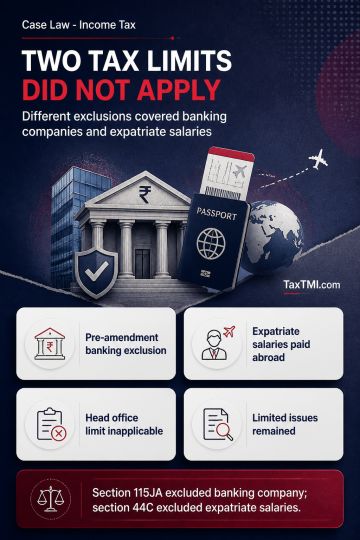
Minimum alternate tax exclusions for pre-amendment banking companies and expatriate Indian branch salaries remain outside head office expenditure limi...
Page of 4805
Press 'Enter' after typing page number.
1201 to 1220 of 96100 Results
❮
❯
❯❯
0 / 200
Expand Note
Add to Folder
No Folders have been created
+
Are you sure you want to delete "My most important" ?
The ITAT Surat held that the penalty u/s 271(1)(c) was not sustainable due to a defective notice and estimation of income on bogus purchases. The notice u/s 274 was issued mechanically without specifying whether the penalty was for 'Concealment of income' or 'furnishing inaccurate particulars of income'. The additions were based on estimation without a definite finding on the quantum of concealment, rendering the penalty unsustainable. Legal precedent from the jurisdictional High Court supported this decision, citing cases such as CIT vs. Subhas Trading Co., Navjivan Oil Mills, and Valimkbhai H. Patel. Therefore, the penalty u/s 271(1)(c) was deemed not sustainable in this case.
The ITAT Surat held that the penalty u/s 271(1)(c) was not sustainable due to a defective notice and estimation of income on bogus purchases. The notice u/s 274 was issued mechanically without specifying whether the penalty was for 'Concealment of income' or 'furnishing inaccurate particulars of income'. The additions were based on estimation without a definite finding on the quantum of concealment, rendering the penalty unsustainable. Legal precedent from the jurisdictional High Court supported this decision, citing cases such as CIT vs. Subhas Trading Co., Navjivan Oil Mills, and Valimkbhai H. Patel. Therefore, the penalty u/s 271(1)(c) was deemed not sustainable in this case.
Note: It is a system-generated summary and is for quick reference only.
 TaxTMI
 of 4805









 Join Channel


 TaxTMI