Commercial vehicle depreciation, scientifically determined warranty provisions and exempt-income disallowances were resolved in favour of the taxpayer...
Inherited property sale proceeds require capital-gains treatment where ownership is supported by evidence, not suspicion or unverified signature doubt...
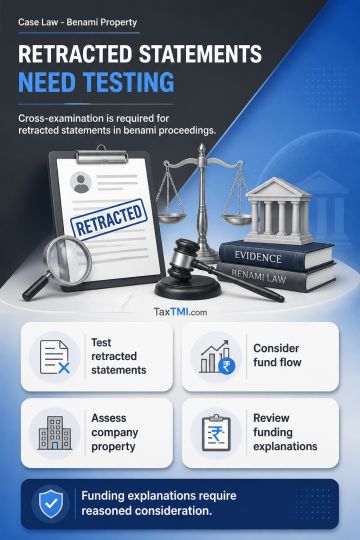
Cross-examination of retracted statements is essential where foundational evidence supports a benami allegation and documented funding explanations re...
The ITAT Surat held that the penalty u/s 271(1)(c) was not sustainable due to a defective notice and estimation of income on bogus purchases. The notice u/s 274 was issued mechanically without specifying whether the penalty was for 'Concealment of income' or 'furnishing inaccurate particulars of income'. The additions were based on estimation without a definite finding on the quantum of concealment, rendering the penalty unsustainable. Legal precedent from the jurisdictional High Court supported this decision, citing cases such as CIT vs. Subhas Trading Co., Navjivan Oil Mills, and Valimkbhai H. Patel. Therefore, the penalty u/s 271(1)(c) was deemed not sustainable in this case.
The ITAT Surat held that the penalty u/s 271(1)(c) was not sustainable due to a defective notice and estimation of income on bogus purchases. The notice u/s 274 was issued mechanically without specifying whether the penalty was for 'Concealment of income' or 'furnishing inaccurate particulars of income'. The additions were based on estimation without a definite finding on the quantum of concealment, rendering the penalty unsustainable. Legal precedent from the jurisdictional High Court supported this decision, citing cases such as CIT vs. Subhas Trading Co., Navjivan Oil Mills, and Valimkbhai H. Patel. Therefore, the penalty u/s 271(1)(c) was deemed not sustainable in this case.
Note: It is a system-generated summary and is for quick reference only.
 TaxTMI
 of 4803













 Join Channel


 TaxTMI