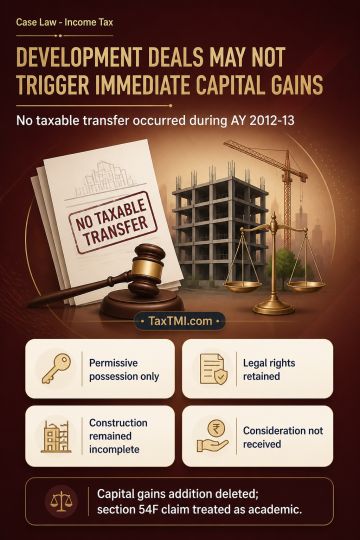
Development agreements require legal possession or effective enjoyment for capital gains transfer; permissive possession and deferred consideration de...
Prolonged sterilisation of development rights supports capital-gains treatment, while business-income disallowances cannot govern capital-gains comput...
Additional evidence in transfer pricing dispute leads to fresh examination, while tax deductions, TDS credit, fee and refund interest require verifica...
Category II AIF pass-through taxation preserves non-business income character; investment receipts cannot be reclassified without applying recognised ...
The ITAT Ahmedabad addressed the validity of an assessment by the AO on issues beyond those covered by a notice u/s 143(2) issued under CASS for limited scrutiny, specifically regarding immovable property under a family arrangement. The Tribunal dismissed the first ground of the assessee, noting that the notice was issued for verifying the purchase of the property in question. Regarding the addition u/s 56(2)(x) of the Act, the Tribunal found that the property was received as part of a family settlement, supported by affidavits and the concept of family arrangements as explained by the Hon'ble Supreme Court. The Tribunal held that the addition made by the AO u/s 56(2)(x) was not sustainable, partially allowing the assessee's appeal. The CIT(A) failed to appreciate the nature of the family arrangement and relevant legal precedents.
The ITAT Ahmedabad addressed the validity of an assessment by the AO on issues beyond those covered by a notice u/s 143(2) issued under CASS for limited scrutiny, specifically regarding immovable property under a family arrangement. The Tribunal dismissed the first ground of the assessee, noting that the notice was issued for verifying the purchase of the property in question. Regarding the addition u/s 56(2)(x) of the Act, the Tribunal found that the property was received as part of a family settlement, supported by affidavits and the concept of family arrangements as explained by the Hon'ble Supreme Court. The Tribunal held that the addition made by the AO u/s 56(2)(x) was not sustainable, partially allowing the assessee's appeal. The CIT(A) failed to appreciate the nature of the family arrangement and relevant legal precedents.
Note: It is a system-generated summary and is for quick reference only.
 TaxTMI
 of 4805















 Join Channel


 TaxTMI
