Toy balloon tariff classification: functional heading prevails over residual rubber and festive article headings, supporting penalties for deliberate ...
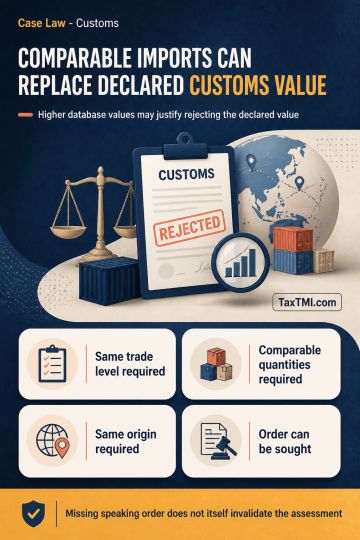
Customs valuation using comparable contemporaneous imports can displace declared value, while missing speaking orders require pursuit before competent...
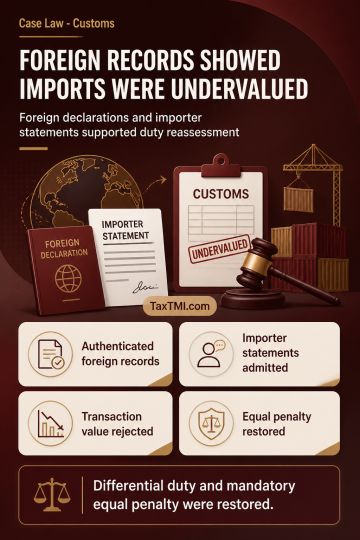
Foreign customs declarations and importer admissions established undervaluation, supporting sequential value redetermination, differential duty, and m...
Customs seizure safeguards prevent detention-based limitation avoidance and invalidate provisional release conditions for imported vehicles under an i...
Page of 4828
Press 'Enter' after typing page number.
361 to 380 of 96556 Results
❮
❯
❯❯
0 / 200
Expand Note
Add to Folder
No Folders have been created
+
Are you sure you want to delete "My most important" ?
The Supreme Court examined the validity of an Agreement to Sell for land, where the plaintiff entered into the agreement with a Power of Attorney holder for the defendants. The Court found that the agreement lacked signatures of all co-owners, and the power of attorney was not proven during trial. The plaintiff failed to appear as a witness, relying on the Power of Attorney holder instead. The Court noted the delay in filing the suit, which was done on the last day of the extended limitation period. As the plaintiff only engaged with one co-owner and delayed legal action despite knowledge of subsequent transactions, specific performance relief was denied due to the delay and failure to meet legal requirements.
The Supreme Court examined the validity of an Agreement to Sell for land, where the plaintiff entered into the agreement with a Power of Attorney holder for the defendants. The Court found that the agreement lacked signatures of all co-owners, and the power of attorney was not proven during trial. The plaintiff failed to appear as a witness, relying on the Power of Attorney holder instead. The Court noted the delay in filing the suit, which was done on the last day of the extended limitation period. As the plaintiff only engaged with one co-owner and delayed legal action despite knowledge of subsequent transactions, specific performance relief was denied due to the delay and failure to meet legal requirements.
Note: It is a system-generated summary and is for quick reference only.
 TaxTMI
  TaxTMI
 of 4828












 Join Channel