Prolonged sterilisation of development rights supports capital-gains treatment, while business-income disallowances cannot govern capital-gains comput...
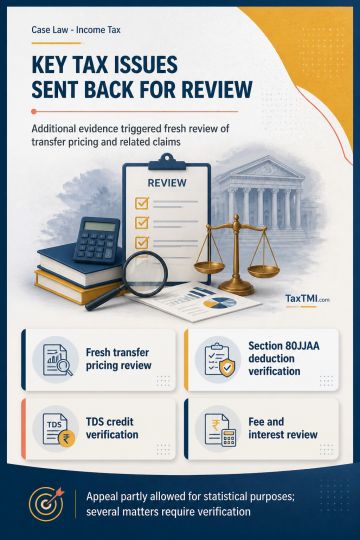
Additional evidence in transfer pricing dispute leads to fresh examination, while tax deductions, TDS credit, fee and refund interest require verifica...
Category II AIF pass-through taxation preserves non-business income character; investment receipts cannot be reclassified without applying recognised ...
Mutual fund maturity rules require proper rollover, redemption, disclosure, and due diligence; investor gains cannot excuse regulatory breaches or pen...
Threshold exemption excludes exempt services, while stamp-paper purchases avoid reverse charge; consequential service tax penalties were also set asid...
The Punjab & Haryana High Court allowed the compounding of the offence u/s 138 N.I. Act between parties in a dishonour of cheque case. Citing precedent, the court held that compounding can be done during trial or by the High Court u/r Section 320(6) Cr.P.C. Settlement led to acquittal u/s 147 of NI Act and Section 320 Cr.P.C. The parties' voluntary settlement justified allowing compounding. The revision petition was allowed, with 15% of the cheque amount to be deposited with a specified center, leading to acquittal of the petitioner from the charge u/s 138 of NI Act.
The Punjab & Haryana High Court allowed the compounding of the offence u/s 138 N.I. Act between parties in a dishonour of cheque case. Citing precedent, the court held that compounding can be done during trial or by the High Court u/r Section 320(6) Cr.P.C. Settlement led to acquittal u/s 147 of NI Act and Section 320 Cr.P.C. The parties' voluntary settlement justified allowing compounding. The revision petition was allowed, with 15% of the cheque amount to be deposited with a specified center, leading to acquittal of the petitioner from the charge u/s 138 of NI Act.
Note: It is a system-generated summary and is for quick reference only.
 TaxTMI
 of 4792


















 Join Channel


 TaxTMI
