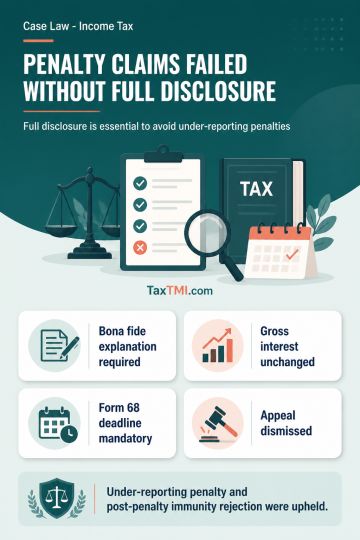
Bona fide disclosure requirements govern under-reporting penalties, and post-penalty immunity applications cannot secure available statutory protectio...
Certificate-of-origin verification procedure governs preferential customs benefits; denial without retroactive verification was set aside with consequ...
Disciplinary Committee jurisdiction and mandatory investigation requirements invalidated cancellation of an insolvency professional's registration and...
Retention of seized property survives where recorded reasons support proceeds of crime, while stayed investigation periods are excluded from limitatio...
The ITAT Mumbai considered a case involving a penalty u/s 271(1)(c) for concealment of income or furnishing inaccurate particulars of income. The Tribunal found the notice issued u/s 274 to be defective and emphasized the importance of clear-cut findings on whether there was concealment or inaccurate particulars. The Tribunal held that confusion in recording satisfaction for penalty initiation renders the penalty unsustainable. It rejected the argument that finality of additions made by the AO warrants penalty, citing the principle that incorrect claims do not equate to inaccurate particulars. The Tribunal concluded that rejection of a claim does not automatically lead to penalty imposition. Based on legal tests and higher court decisions, the Tribunal upheld the deletion of the penalty, stating that the decision was neither perverse nor illegal. As a result, the Revenue's appeal was dismissed.
The ITAT Mumbai considered a case involving a penalty u/s 271(1)(c) for concealment of income or furnishing inaccurate particulars of income. The Tribunal found the notice issued u/s 274 to be defective and emphasized the importance of clear-cut findings on whether there was concealment or inaccurate particulars. The Tribunal held that confusion in recording satisfaction for penalty initiation renders the penalty unsustainable. It rejected the argument that finality of additions made by the AO warrants penalty, citing the principle that incorrect claims do not equate to inaccurate particulars. The Tribunal concluded that rejection of a claim does not automatically lead to penalty imposition. Based on legal tests and higher court decisions, the Tribunal upheld the deletion of the penalty, stating that the decision was neither perverse nor illegal. As a result, the Revenue's appeal was dismissed.
Note: It is a system-generated summary and is for quick reference only.
 TaxTMI
 of 4792




















 Join Channel


 TaxTMI
