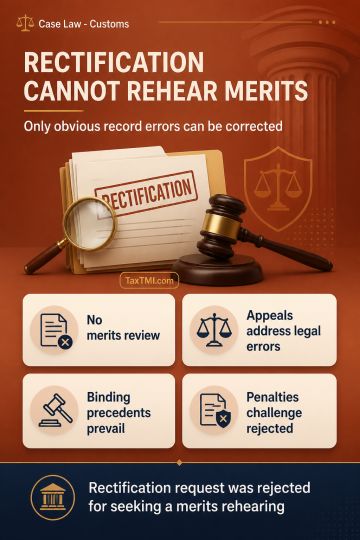
Rectification of mistake remains limited to self-evident record errors, preventing merits review through miscellaneous applications and preserving fin...
Tender creditworthiness conditions may extend to de facto Promoter Directors, with post-participation challenges generally barred absent arbitrariness...
Corporate representation in PMLA summons proceedings permitted through an authorised signatory, subject to directors' continuing cooperation and atten...
Helicopter charter classification requires effective control analysis, while territorial performance, reasoned credit orders and wilful suppression de...
Specified fund definition expands PAN exemption eligibility for registered alternative investment funds and qualifying International Financial Service...
The ITAT Mumbai considered a case involving a penalty u/s 271(1)(c) for concealment of income or furnishing inaccurate particulars of income. The Tribunal found the notice issued u/s 274 to be defective and emphasized the importance of clear-cut findings on whether there was concealment or inaccurate particulars. The Tribunal held that confusion in recording satisfaction for penalty initiation renders the penalty unsustainable. It rejected the argument that finality of additions made by the AO warrants penalty, citing the principle that incorrect claims do not equate to inaccurate particulars. The Tribunal concluded that rejection of a claim does not automatically lead to penalty imposition. Based on legal tests and higher court decisions, the Tribunal upheld the deletion of the penalty, stating that the decision was neither perverse nor illegal. As a result, the Revenue's appeal was dismissed.
The ITAT Mumbai considered a case involving a penalty u/s 271(1)(c) for concealment of income or furnishing inaccurate particulars of income. The Tribunal found the notice issued u/s 274 to be defective and emphasized the importance of clear-cut findings on whether there was concealment or inaccurate particulars. The Tribunal held that confusion in recording satisfaction for penalty initiation renders the penalty unsustainable. It rejected the argument that finality of additions made by the AO warrants penalty, citing the principle that incorrect claims do not equate to inaccurate particulars. The Tribunal concluded that rejection of a claim does not automatically lead to penalty imposition. Based on legal tests and higher court decisions, the Tribunal upheld the deletion of the penalty, stating that the decision was neither perverse nor illegal. As a result, the Revenue's appeal was dismissed.
Note: It is a system-generated summary and is for quick reference only.
 TaxTMI
 of 4786





















 Join Channel


 TaxTMI
