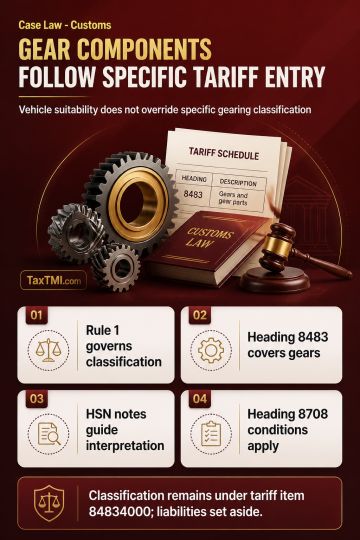
Tariff classification of vehicle gear components follows the specific gearing entry, displacing motor-vehicle parts classification and related liabili...
Necessary-party requirements limit impleadment of independent entities, while deferred consideration does not create an appealable adverse determinati...
Food supplement classification requires common parlance and authoritative tests, preventing treatment as proprietary Ayurvedic medicines without suppo...
Specified regulatory authority income receives conditional tax exemption, subject to non-commercial activity, unchanged income character, and return f...
Tax exemption for regulatory authority income applies retrospectively, subject to non-commercial activity, unchanged income sources, and return-filing...
The ITAT Mumbai considered a case involving a penalty u/s 271(1)(c) for concealment of income or furnishing inaccurate particulars of income. The Tribunal found the notice issued u/s 274 to be defective and emphasized the importance of clear-cut findings on whether there was concealment or inaccurate particulars. The Tribunal held that confusion in recording satisfaction for penalty initiation renders the penalty unsustainable. It rejected the argument that finality of additions made by the AO warrants penalty, citing the principle that incorrect claims do not equate to inaccurate particulars. The Tribunal concluded that rejection of a claim does not automatically lead to penalty imposition. Based on legal tests and higher court decisions, the Tribunal upheld the deletion of the penalty, stating that the decision was neither perverse nor illegal. As a result, the Revenue's appeal was dismissed.
The ITAT Mumbai considered a case involving a penalty u/s 271(1)(c) for concealment of income or furnishing inaccurate particulars of income. The Tribunal found the notice issued u/s 274 to be defective and emphasized the importance of clear-cut findings on whether there was concealment or inaccurate particulars. The Tribunal held that confusion in recording satisfaction for penalty initiation renders the penalty unsustainable. It rejected the argument that finality of additions made by the AO warrants penalty, citing the principle that incorrect claims do not equate to inaccurate particulars. The Tribunal concluded that rejection of a claim does not automatically lead to penalty imposition. Based on legal tests and higher court decisions, the Tribunal upheld the deletion of the penalty, stating that the decision was neither perverse nor illegal. As a result, the Revenue's appeal was dismissed.
Note: It is a system-generated summary and is for quick reference only.
 TaxTMI
 of 4782





















 Join Channel


 TaxTMI
