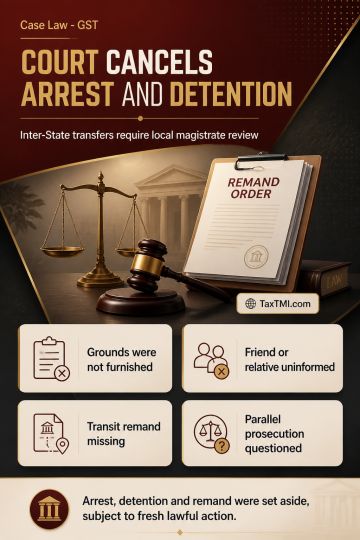
Arrest safeguards and transit remand requirements invalidated detention following inter-State transfer without communicated grounds or magistrate auth...
Arrest safeguards require disclosed grounds, relative intimation and transit remand, while duplicate prosecution under the CGST framework is unsustain...
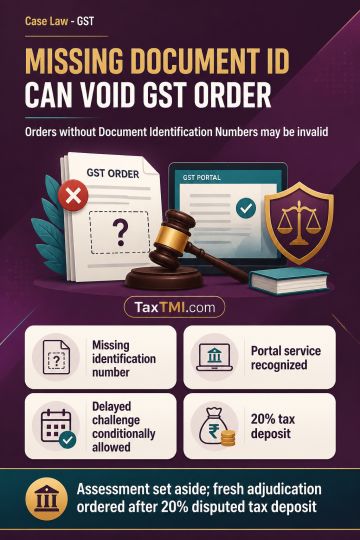
Document Identification Number defects can invalidate GST assessments, with delayed challenges entertained conditionally where patent irregularities e...
Windmill commissioning evidence supported higher depreciation where grid connection and electricity generation proved operational use before the relev...
Pharmaceutical promotion and transfer-pricing comparability principles limited disallowances, while uncorroborated search allegations and unsupported ...
Business expenditure substantiation supports scrap credits, statutory payments and expense claims, while depreciation requires proof of actual busines...
Page of 4794
Press 'Enter' after typing page number.
621 to 640 of 95875 Results
❮
❯
❯❯
0 / 200
Expand Note
Add to Folder
No Folders have been created
+
Are you sure you want to delete "My most important" ?
The ITAT Ahmedabad addressed the jurisdiction of the AO over a corporate assessee with income exceeding Rs. 30 Lakhs in metro cities. The tribunal confirmed that income, as per Section 2(24) of the Income Tax Act, includes losses. Referring to legal precedents, it was established that income encompasses losses. Therefore, the CBDT Instruction on jurisdiction applied to cases of both income and losses over Rs. 30 Lakhs. The DCIT's issuance of notice u/s 143(2) was deemed appropriate. The rejection of the assessee's books of account and estimation of profit at 10% of total receipts were upheld. The assessee's failure to provide proper accounts and evidence led to the rejection. The AO's estimation of income at 10% was considered reasonable, given the nature of the assessee's work and the prescribed rate under the Act. The tribunal declined to interfere with the AO's income estimation.
The ITAT Ahmedabad addressed the jurisdiction of the AO over a corporate assessee with income exceeding Rs. 30 Lakhs in metro cities. The tribunal confirmed that income, as per Section 2(24) of the Income Tax Act, includes losses. Referring to legal precedents, it was established that income encompasses losses. Therefore, the CBDT Instruction on jurisdiction applied to cases of both income and losses over Rs. 30 Lakhs. The DCIT's issuance of notice u/s 143(2) was deemed appropriate. The rejection of the assessee's books of account and estimation of profit at 10% of total receipts were upheld. The assessee's failure to provide proper accounts and evidence led to the rejection. The AO's estimation of income at 10% was considered reasonable, given the nature of the assessee's work and the prescribed rate under the Act. The tribunal declined to interfere with the AO's income estimation.
Note: It is a system-generated summary and is for quick reference only.
 TaxTMI
 of 4794


















 Join Channel


 TaxTMI