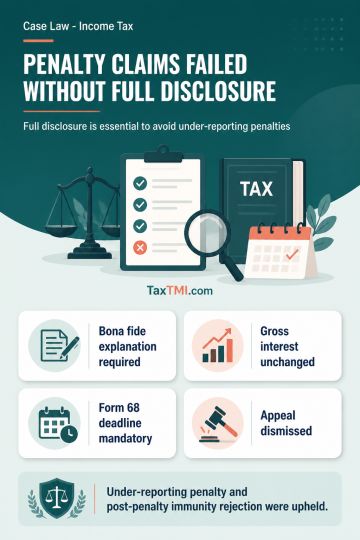
Bona fide disclosure requirements govern under-reporting penalties, and post-penalty immunity applications cannot secure available statutory protectio...
Certificate-of-origin verification procedure governs preferential customs benefits; denial without retroactive verification was set aside with consequ...
Disciplinary Committee jurisdiction and mandatory investigation requirements invalidated cancellation of an insolvency professional's registration and...
Retention of seized property survives where recorded reasons support proceeds of crime, while stayed investigation periods are excluded from limitatio...
The case before the Calcutta High Court involved the classification of a company for taxation purposes. The court determined that the appellant company did not qualify as a domestic company but fell under the category of "a company other than a domestic company." The court relied on the definitions provided in the Income Tax Act, 1961 to make this classification. The court also addressed the issue of taxation rates, highlighting the distinction between domestic and foreign companies. The court found that the appellant was liable to be taxed at the rate applicable to a company other than a domestic company. Additionally, the court analyzed the relationship between the domestic tax laws and the Double Taxation Avoidance Agreement (DTAA) with the Netherlands. It concluded that there was no conflict between the Explanation to Section 90 of the Income Tax Act, 1961 and Article 24(2) of the DTAA.
The case before the Calcutta High Court involved the classification of a company for taxation purposes. The court determined that the appellant company did not qualify as a domestic company but fell under the category of "a company other than a domestic company." The court relied on the definitions provided in the Income Tax Act, 1961 to make this classification. The court also addressed the issue of taxation rates, highlighting the distinction between domestic and foreign companies. The court found that the appellant was liable to be taxed at the rate applicable to a company other than a domestic company. Additionally, the court analyzed the relationship between the domestic tax laws and the Double Taxation Avoidance Agreement (DTAA) with the Netherlands. It concluded that there was no conflict between the Explanation to Section 90 of the Income Tax Act, 1961 and Article 24(2) of the DTAA.
Note: It is a system-generated summary and is for quick reference only.
 TaxTMI
 of 4792




















 Join Channel


 TaxTMI
