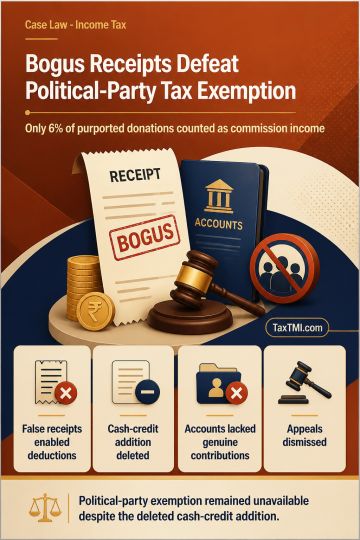
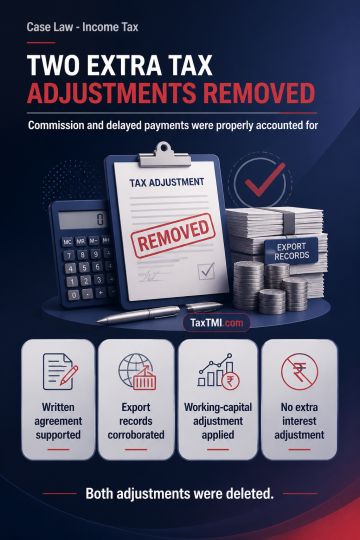
Bogus donation receipts justified commission income assessment and defeated political-party tax exemption for inaccurate accounts and reporting failur...
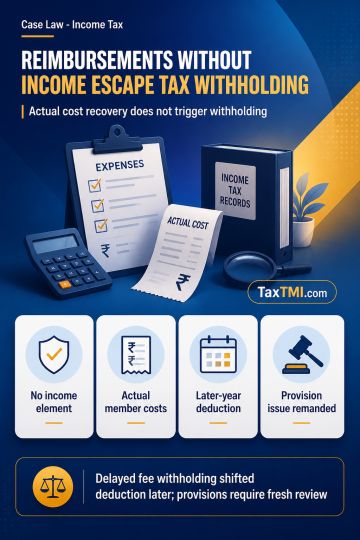
Pure reimbursement without income element escapes tax withholding, while delayed withholding and unsupported provisions face deferred or renewed scrut...
Public benefit requirement defeats charitable registration where residents' association services are reciprocal, member-only facilities governed by mu...
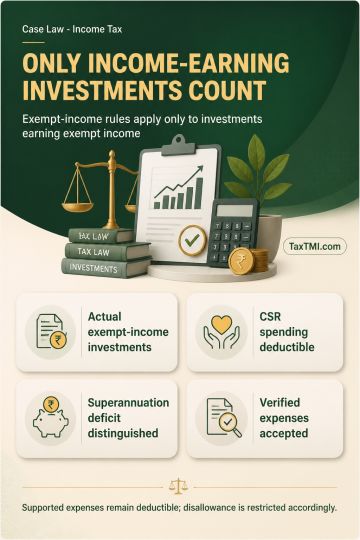
Exempt-income expenditure disallowance is confined to investments that actually generated exempt income, while supported business expenses remain dedu...
The case before the Calcutta High Court involved the classification of a company for taxation purposes. The court determined that the appellant company did not qualify as a domestic company but fell under the category of "a company other than a domestic company." The court relied on the definitions provided in the Income Tax Act, 1961 to make this classification. The court also addressed the issue of taxation rates, highlighting the distinction between domestic and foreign companies. The court found that the appellant was liable to be taxed at the rate applicable to a company other than a domestic company. Additionally, the court analyzed the relationship between the domestic tax laws and the Double Taxation Avoidance Agreement (DTAA) with the Netherlands. It concluded that there was no conflict between the Explanation to Section 90 of the Income Tax Act, 1961 and Article 24(2) of the DTAA.
The case before the Calcutta High Court involved the classification of a company for taxation purposes. The court determined that the appellant company did not qualify as a domestic company but fell under the category of "a company other than a domestic company." The court relied on the definitions provided in the Income Tax Act, 1961 to make this classification. The court also addressed the issue of taxation rates, highlighting the distinction between domestic and foreign companies. The court found that the appellant was liable to be taxed at the rate applicable to a company other than a domestic company. Additionally, the court analyzed the relationship between the domestic tax laws and the Double Taxation Avoidance Agreement (DTAA) with the Netherlands. It concluded that there was no conflict between the Explanation to Section 90 of the Income Tax Act, 1961 and Article 24(2) of the DTAA.
Note: It is a system-generated summary and is for quick reference only.
 TaxTMI
 of 4784











 Join Channel


 TaxTMI