Inherited property sale proceeds require capital-gains treatment where ownership is supported by evidence, not suspicion or unverified signature doubt...
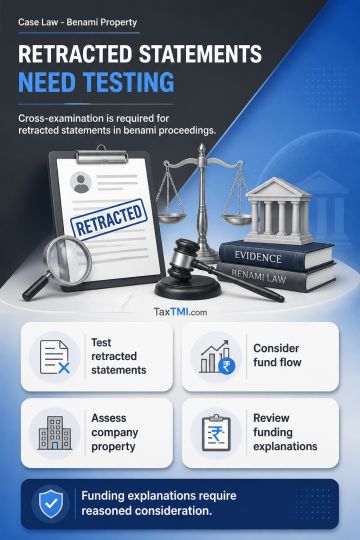
Cross-examination of retracted statements is essential where foundational evidence supports a benami allegation and documented funding explanations re...
Capital-goods exemption covers plant-modernisation accessories, while the import restriction applies only to earlier capital-goods components and spar...
Constitutional judicial review permits challenges to ECIRs and connected money-laundering proceedings where coercive action affects fundamental intere...
The case before the Calcutta High Court involved the classification of a company for taxation purposes. The court determined that the appellant company did not qualify as a domestic company but fell under the category of "a company other than a domestic company." The court relied on the definitions provided in the Income Tax Act, 1961 to make this classification. The court also addressed the issue of taxation rates, highlighting the distinction between domestic and foreign companies. The court found that the appellant was liable to be taxed at the rate applicable to a company other than a domestic company. Additionally, the court analyzed the relationship between the domestic tax laws and the Double Taxation Avoidance Agreement (DTAA) with the Netherlands. It concluded that there was no conflict between the Explanation to Section 90 of the Income Tax Act, 1961 and Article 24(2) of the DTAA.
The case before the Calcutta High Court involved the classification of a company for taxation purposes. The court determined that the appellant company did not qualify as a domestic company but fell under the category of "a company other than a domestic company." The court relied on the definitions provided in the Income Tax Act, 1961 to make this classification. The court also addressed the issue of taxation rates, highlighting the distinction between domestic and foreign companies. The court found that the appellant was liable to be taxed at the rate applicable to a company other than a domestic company. Additionally, the court analyzed the relationship between the domestic tax laws and the Double Taxation Avoidance Agreement (DTAA) with the Netherlands. It concluded that there was no conflict between the Explanation to Section 90 of the Income Tax Act, 1961 and Article 24(2) of the DTAA.
Note: It is a system-generated summary and is for quick reference only.
 TaxTMI
 of 4780




















 Join Channel


 TaxTMI