Authentication of paper assessment orders upheld, while qualifying repairs, consumables and vendor advance write-offs remain deductible business claim...
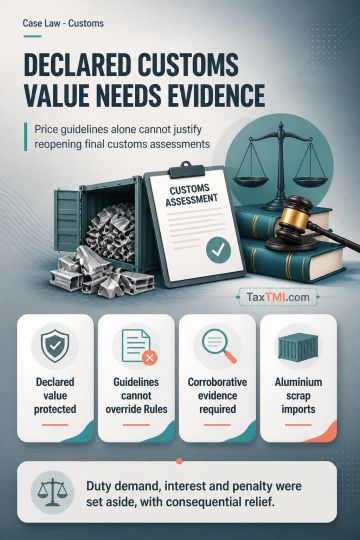
Transaction value cannot be rejected solely on non-statutory valuation guidelines without corroborative evidence supporting reassessment of final cust...
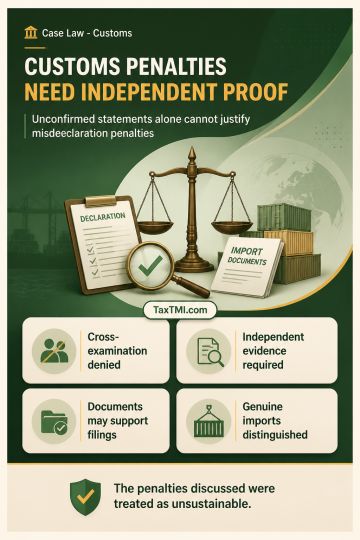
Cross-examination rights and corroborated evidence limit customs penalties for misdeclaration in genuine import transactions involving documented clea...
Tariff classification of vehicle gear components follows the specific gearing entry, displacing motor-vehicle parts classification and related liabili...
The case before the Calcutta High Court involved the classification of a company for taxation purposes. The court determined that the appellant company did not qualify as a domestic company but fell under the category of "a company other than a domestic company." The court relied on the definitions provided in the Income Tax Act, 1961 to make this classification. The court also addressed the issue of taxation rates, highlighting the distinction between domestic and foreign companies. The court found that the appellant was liable to be taxed at the rate applicable to a company other than a domestic company. Additionally, the court analyzed the relationship between the domestic tax laws and the Double Taxation Avoidance Agreement (DTAA) with the Netherlands. It concluded that there was no conflict between the Explanation to Section 90 of the Income Tax Act, 1961 and Article 24(2) of the DTAA.
The case before the Calcutta High Court involved the classification of a company for taxation purposes. The court determined that the appellant company did not qualify as a domestic company but fell under the category of "a company other than a domestic company." The court relied on the definitions provided in the Income Tax Act, 1961 to make this classification. The court also addressed the issue of taxation rates, highlighting the distinction between domestic and foreign companies. The court found that the appellant was liable to be taxed at the rate applicable to a company other than a domestic company. Additionally, the court analyzed the relationship between the domestic tax laws and the Double Taxation Avoidance Agreement (DTAA) with the Netherlands. It concluded that there was no conflict between the Explanation to Section 90 of the Income Tax Act, 1961 and Article 24(2) of the DTAA.
Note: It is a system-generated summary and is for quick reference only.
 TaxTMI
 of 4784
















 Join Channel


 TaxTMI