Joint development agreements defer taxable transfer where possession lacks part performance, while completed flats determine consideration and exempti...
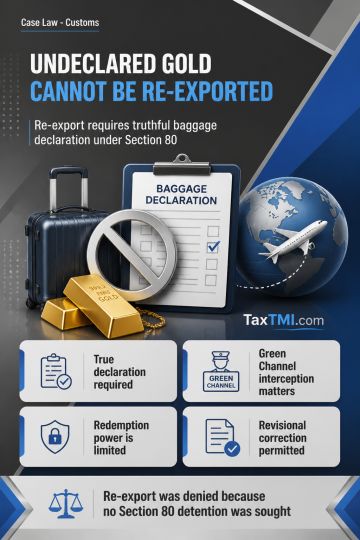
Passenger baggage re-export requires true declaration and cannot be granted indirectly through discretionary redemption of undeclared prohibited goods...
The case involved the classification of Diagnostic Kits as "drugs" under the Drugs and Cosmetics Act, 1940. The court held that devices used for diagnosis fall under the definition of "drug" only if specified by the Central Government in the Official Gazette. Diagnostic Kits were deemed more akin to "devices" than "medicines" and would be considered as "drugs" under sub-section (iv) of Section 3 (b) if notified by the Central Government. The court noted the absence of evidence showing Diagnostic Kits are considered "medicines" or "drugs" by medical practitioners. If the Kits are notified as "drugs," they would be charged at 4% under Entry 48 of Schedule C; otherwise, they would fall under Entry 165 of Schedule D and be taxed at 12.5%. The court disposed of the petition accordingly.
The case involved the classification of Diagnostic Kits as "drugs" under the Drugs and Cosmetics Act, 1940. The court held that devices used for diagnosis fall under the definition of "drug" only if specified by the Central Government in the Official Gazette. Diagnostic Kits were deemed more akin to "devices" than "medicines" and would be considered as "drugs" under sub-section (iv) of Section 3 (b) if notified by the Central Government. The court noted the absence of evidence showing Diagnostic Kits are considered "medicines" or "drugs" by medical practitioners. If the Kits are notified as "drugs," they would be charged at 4% under Entry 48 of Schedule C; otherwise, they would fall under Entry 165 of Schedule D and be taxed at 12.5%. The court disposed of the petition accordingly.
Note: It is a system-generated summary and is for quick reference only.
 TaxTMI
 of 4786













 Join Channel


 TaxTMI
