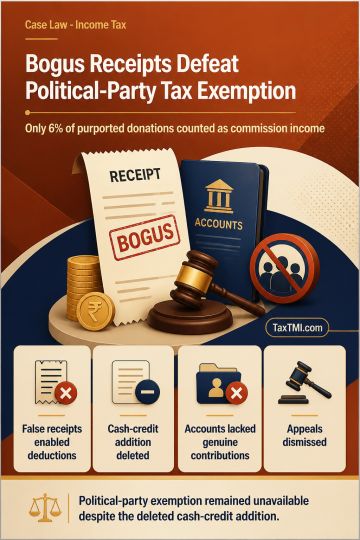
Bogus donation receipts justified commission income assessment and defeated political-party tax exemption for inaccurate accounts and reporting failur...
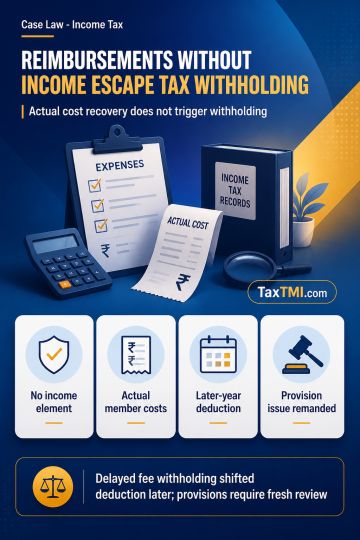
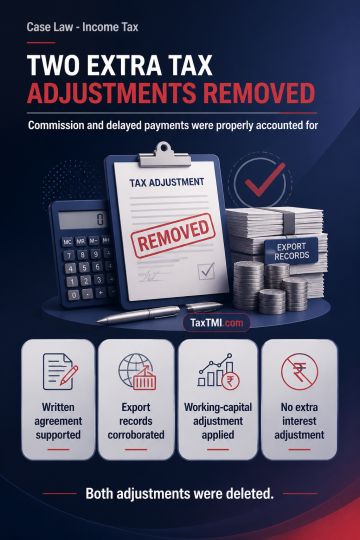
Pure reimbursement without income element escapes tax withholding, while delayed withholding and unsupported provisions face deferred or renewed scrut...
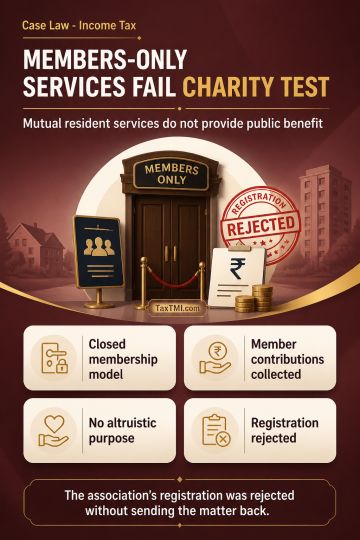
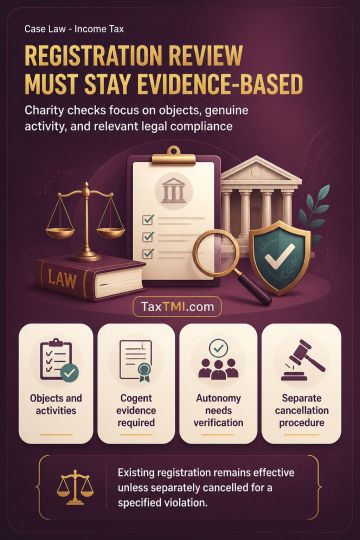
Public benefit requirement defeats charitable registration where residents' association services are reciprocal, member-only facilities governed by mu...
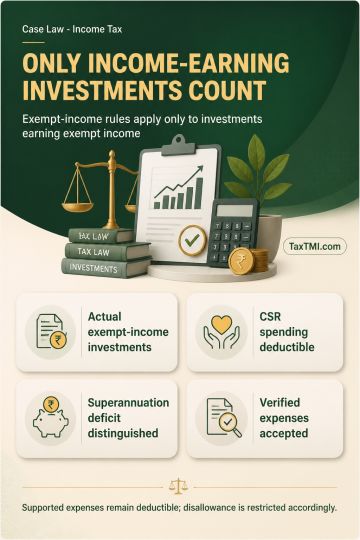
Exempt-income expenditure disallowance is confined to investments that actually generated exempt income, while supported business expenses remain dedu...
In the case of 2024 (5) TMI 1132 before the ITAT Mumbai, the issue pertained to penalty proceedings u/s. 271(1)(c) concerning the estimation of income on bogus purchases. The CIT(A) applied a gross profit rate of 10% on the bogus purchases instead of the entire amount added by the assessing officer, leading to the deletion of the penalty. The tribunal held that since the payments for the purchases were evidenced in the books and through banking channels, with corresponding utilization in the manufacturing account accepted, the entire purchases could not have been added u/s. 69C. The decision was in line with precedents such as PCIT vs. Jagdish Thakkar and PCIT vs. S V Jiwani. Consequently, the appeal of the Revenue was dismissed as there was no concealment of income based on the estimated profit rate of 10%. The penalty was rightly deleted by the CIT(A), as there was no furnishing of inaccurate particulars or concealment of income.
In the case of 2024 (5) TMI 1132 before the ITAT Mumbai, the issue pertained to penalty proceedings u/s. 271(1)(c) concerning the estimation of income on bogus purchases. The CIT(A) applied a gross profit rate of 10% on the bogus purchases instead of the entire amount added by the assessing officer, leading to the deletion of the penalty. The tribunal held that since the payments for the purchases were evidenced in the books and through banking channels, with corresponding utilization in the manufacturing account accepted, the entire purchases could not have been added u/s. 69C. The decision was in line with precedents such as PCIT vs. Jagdish Thakkar and PCIT vs. S V Jiwani. Consequently, the appeal of the Revenue was dismissed as there was no concealment of income based on the estimated profit rate of 10%. The penalty was rightly deleted by the CIT(A), as there was no furnishing of inaccurate particulars or concealment of income.
Note: It is a system-generated summary and is for quick reference only.
 TaxTMI
 of 4792




 Join Channel


 TaxTMI