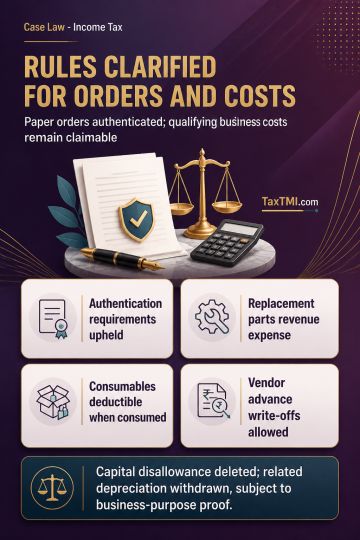
Authentication of paper assessment orders upheld, while qualifying repairs, consumables and vendor advance write-offs remain deductible business claim...
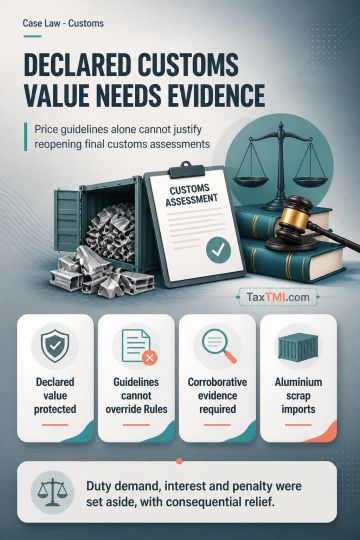
Transaction value cannot be rejected solely on non-statutory valuation guidelines without corroborative evidence supporting reassessment of final cust...
Cross-examination rights and corroborated evidence limit customs penalties for misdeclaration in genuine import transactions involving documented clea...
Page of 4796
Press 'Enter' after typing page number.
581 to 600 of 95916 Results
❮
❯
❯❯
0 / 200
Expand Note
Add to Folder
No Folders have been created
+
Are you sure you want to delete "My most important" ?
The ITAT Delhi held that the merger of intimation/proceedings u/s 143(1) with regular assessment u/s 143(3) results in the intimation losing relevance once regular assessment is completed. The AO denied exemption u/s 11 due to non-filing of Form 10B, but the intimation u/s 143(1) only serves to verify information accuracy and does not carry the legitimacy of an assessment. The intimation merges with the regular assessment under u/s 143(3), making the appeal against the intimation infructuous. The eligibility for exemption u/s 11 post registration u/s 12A should be raised in the appeal against the regular assessment. The appeal was partly allowed in favor of the assessee, determining the demand raised in the 143(1) intimation as not sustainable.
The ITAT Delhi held that the merger of intimation/proceedings u/s 143(1) with regular assessment u/s 143(3) results in the intimation losing relevance once regular assessment is completed. The AO denied exemption u/s 11 due to non-filing of Form 10B, but the intimation u/s 143(1) only serves to verify information accuracy and does not carry the legitimacy of an assessment. The intimation merges with the regular assessment under u/s 143(3), making the appeal against the intimation infructuous. The eligibility for exemption u/s 11 post registration u/s 12A should be raised in the appeal against the regular assessment. The appeal was partly allowed in favor of the assessee, determining the demand raised in the 143(1) intimation as not sustainable.
Note: It is a system-generated summary and is for quick reference only.
 TaxTMI
 of 4796







 Join Channel


 TaxTMI

