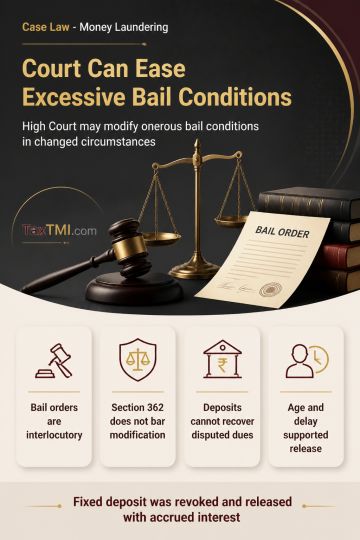
Modification of bail conditions remains available through inherent jurisdiction where onerous deposits undermine justice and cannot recover disputed d...
Merchant banker regulation consolidates registration, governance, capital, reporting, outsourcing and investor-protection requirements under an update...
Authentication of paper assessment orders upheld, while qualifying repairs, consumables and vendor advance write-offs remain deductible business claim...
The ITAT Delhi addressed an addition u/s 41(1) converted from u/s 68, focusing on whether there was actual receipt of money or just journal entries for account adjustments. The AR argued that the entries were for loan adjustments from a prior year. The tribunal found the CIT(A)'s conclusion erroneous as there was no actual receipt of money, only journal entries reflecting borrowed funds and liabilities transferred to M/s Vrinda Developers Pvt. Ltd. The tribunal held that the journal entry did not constitute unexplained cash credit u/s 68, as it was a book entry transfer without a real cash credit. Citing a similar case, the tribunal emphasized the need for actual flow of funds to trigger the explanation requirement. Additionally, the tribunal allowed the expenditure related to a project started in the relevant year, despite the invoice being raised in the previous year. The decision favored the assessee based on project-related expenditure evidence.
The ITAT Delhi addressed an addition u/s 41(1) converted from u/s 68, focusing on whether there was actual receipt of money or just journal entries for account adjustments. The AR argued that the entries were for loan adjustments from a prior year. The tribunal found the CIT(A)'s conclusion erroneous as there was no actual receipt of money, only journal entries reflecting borrowed funds and liabilities transferred to M/s Vrinda Developers Pvt. Ltd. The tribunal held that the journal entry did not constitute unexplained cash credit u/s 68, as it was a book entry transfer without a real cash credit. Citing a similar case, the tribunal emphasized the need for actual flow of funds to trigger the explanation requirement. Additionally, the tribunal allowed the expenditure related to a project started in the relevant year, despite the invoice being raised in the previous year. The decision favored the assessee based on project-related expenditure evidence.
Note: It is a system-generated summary and is for quick reference only.
 TaxTMI
 of 4787
















 Join Channel


 TaxTMI
