Opportunity to respond to jurisdictional reports is mandatory before customs settlement duty enhancement; connected applications require consistent ad...
Specific customs headings for scaffolding components prevail over general classification, invalidating misclassification proceedings and enabling with...
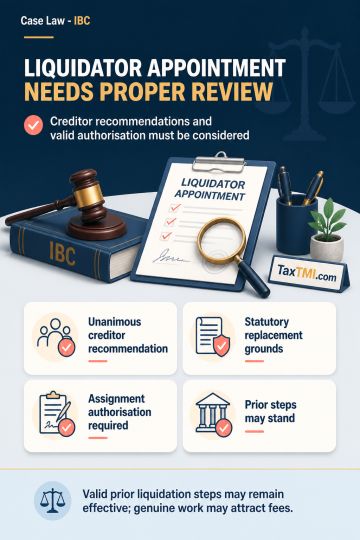
Liquidator appointment under Section 34 requires consideration of creditor recommendations, valid professional authorisation, and preservation of vali...
The ITAT Delhi addressed an addition u/s 41(1) converted from u/s 68, focusing on whether there was actual receipt of money or just journal entries for account adjustments. The AR argued that the entries were for loan adjustments from a prior year. The tribunal found the CIT(A)'s conclusion erroneous as there was no actual receipt of money, only journal entries reflecting borrowed funds and liabilities transferred to M/s Vrinda Developers Pvt. Ltd. The tribunal held that the journal entry did not constitute unexplained cash credit u/s 68, as it was a book entry transfer without a real cash credit. Citing a similar case, the tribunal emphasized the need for actual flow of funds to trigger the explanation requirement. Additionally, the tribunal allowed the expenditure related to a project started in the relevant year, despite the invoice being raised in the previous year. The decision favored the assessee based on project-related expenditure evidence.
The ITAT Delhi addressed an addition u/s 41(1) converted from u/s 68, focusing on whether there was actual receipt of money or just journal entries for account adjustments. The AR argued that the entries were for loan adjustments from a prior year. The tribunal found the CIT(A)'s conclusion erroneous as there was no actual receipt of money, only journal entries reflecting borrowed funds and liabilities transferred to M/s Vrinda Developers Pvt. Ltd. The tribunal held that the journal entry did not constitute unexplained cash credit u/s 68, as it was a book entry transfer without a real cash credit. Citing a similar case, the tribunal emphasized the need for actual flow of funds to trigger the explanation requirement. Additionally, the tribunal allowed the expenditure related to a project started in the relevant year, despite the invoice being raised in the previous year. The decision favored the assessee based on project-related expenditure evidence.
Note: It is a system-generated summary and is for quick reference only.
 TaxTMI
 of 4784
















 Join Channel


 TaxTMI