Development agreements require legal possession or effective enjoyment for capital gains transfer; permissive possession and deferred consideration de...
Prolonged sterilisation of development rights supports capital-gains treatment, while business-income disallowances cannot govern capital-gains comput...
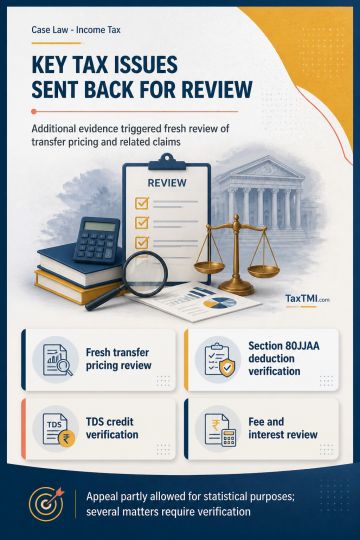
Additional evidence in transfer pricing dispute leads to fresh examination, while tax deductions, TDS credit, fee and refund interest require verifica...
Category II AIF pass-through taxation preserves non-business income character; investment receipts cannot be reclassified without applying recognised ...
The ITAT Hyderabad addressed the issue of determining the correct head of income for gains on the sale of property, whether it should be classified as business income or capital gains based on the intention of the assessee. The tribunal emphasized the importance of consistency in applying decisions across connected assessees with similar Joint Development Agreements (JDA). The tribunal held that if a co-ordinate Bench had previously ruled in favor of an assessee with rights from the same JDA, the principle should be applied uniformly unless there is a change in law or facts. The Revenue's inconsistent treatment of assessees in similar situations was deemed unacceptable, as it goes against the principle of certainty and fairness in tax law. The tribunal also upheld the CIT(A)'s decision to treat the income as long-term capital gains, in line with the co-ordinate Bench's reasoning and circulars issued by the Revenue.
The ITAT Hyderabad addressed the issue of determining the correct head of income for gains on the sale of property, whether it should be classified as business income or capital gains based on the intention of the assessee. The tribunal emphasized the importance of consistency in applying decisions across connected assessees with similar Joint Development Agreements (JDA). The tribunal held that if a co-ordinate Bench had previously ruled in favor of an assessee with rights from the same JDA, the principle should be applied uniformly unless there is a change in law or facts. The Revenue's inconsistent treatment of assessees in similar situations was deemed unacceptable, as it goes against the principle of certainty and fairness in tax law. The tribunal also upheld the CIT(A)'s decision to treat the income as long-term capital gains, in line with the co-ordinate Bench's reasoning and circulars issued by the Revenue.
Note: It is a system-generated summary and is for quick reference only.
 TaxTMI
 of 4800



















 Join Channel


 TaxTMI
