Cooperative society deposits, member-interest TDS exemption and credit-facility deduction claims require verification through records and supporting e...
Customs jurisdiction over EPCG condition breaches survives export-obligation discharge certificates, requiring alleged fraud and misdeclaration to be ...
Contractual tolerance requires consideration; breach recoveries, qualifying public infrastructure services and road works escape service tax liability...
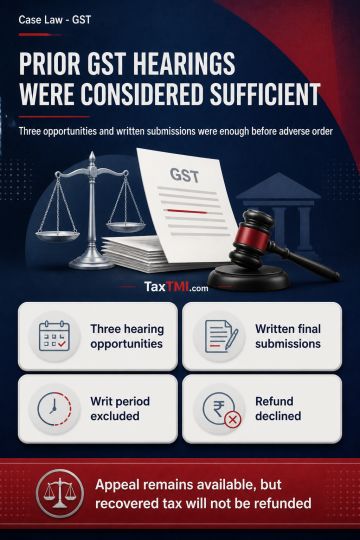
Personal hearing requirements in GST adjudication were satisfied by prior opportunities and written submissions; appellate limitation received writ-pe...
The ITAT Hyderabad addressed the issue of determining the correct head of income for gains on the sale of property, whether it should be classified as business income or capital gains based on the intention of the assessee. The tribunal emphasized the importance of consistency in applying decisions across connected assessees with similar Joint Development Agreements (JDA). The tribunal held that if a co-ordinate Bench had previously ruled in favor of an assessee with rights from the same JDA, the principle should be applied uniformly unless there is a change in law or facts. The Revenue's inconsistent treatment of assessees in similar situations was deemed unacceptable, as it goes against the principle of certainty and fairness in tax law. The tribunal also upheld the CIT(A)'s decision to treat the income as long-term capital gains, in line with the co-ordinate Bench's reasoning and circulars issued by the Revenue.
The ITAT Hyderabad addressed the issue of determining the correct head of income for gains on the sale of property, whether it should be classified as business income or capital gains based on the intention of the assessee. The tribunal emphasized the importance of consistency in applying decisions across connected assessees with similar Joint Development Agreements (JDA). The tribunal held that if a co-ordinate Bench had previously ruled in favor of an assessee with rights from the same JDA, the principle should be applied uniformly unless there is a change in law or facts. The Revenue's inconsistent treatment of assessees in similar situations was deemed unacceptable, as it goes against the principle of certainty and fairness in tax law. The tribunal also upheld the CIT(A)'s decision to treat the income as long-term capital gains, in line with the co-ordinate Bench's reasoning and circulars issued by the Revenue.
Note: It is a system-generated summary and is for quick reference only.
 TaxTMI
 of 4792


















 Join Channel


 TaxTMI