Tax exemption for regulatory authority income applies retrospectively, subject to non-commercial activity, unchanged income sources, and return filing...
Dispute Resolution Panel objections must reach both prescribed forums; otherwise assessment may proceed and statutory appeal remains the proper remedy...
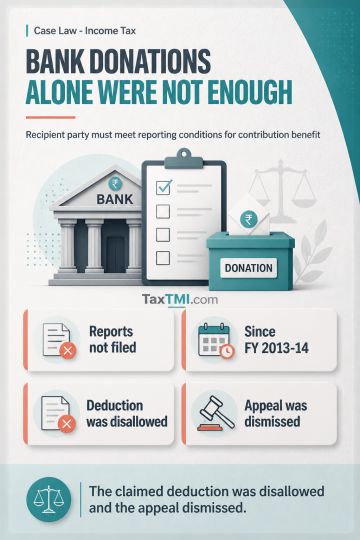
Political contribution deductions require recipient party compliance with contribution-reporting conditions; banking-channel donations alone do not qu...
Aggregation under TNMM prevents selective testing of intra-group services without comparable uncontrolled transactions, while appellate additional cla...
Page of 4790
Press 'Enter' after typing page number.
421 to 440 of 95794 Results
❮
❯
❯❯
0 / 200
Expand Note
Add to Folder
No Folders have been created
+
Are you sure you want to delete "My most important" ?
The ITAT Hyderabad addressed the issue of determining the correct head of income for gains on the sale of property, whether it should be classified as business income or capital gains based on the intention of the assessee. The tribunal emphasized the importance of consistency in applying decisions across connected assessees with similar Joint Development Agreements (JDA). The tribunal held that if a co-ordinate Bench had previously ruled in favor of an assessee with rights from the same JDA, the principle should be applied uniformly unless there is a change in law or facts. The Revenue's inconsistent treatment of assessees in similar situations was deemed unacceptable, as it goes against the principle of certainty and fairness in tax law. The tribunal also upheld the CIT(A)'s decision to treat the income as long-term capital gains, in line with the co-ordinate Bench's reasoning and circulars issued by the Revenue.
The ITAT Hyderabad addressed the issue of determining the correct head of income for gains on the sale of property, whether it should be classified as business income or capital gains based on the intention of the assessee. The tribunal emphasized the importance of consistency in applying decisions across connected assessees with similar Joint Development Agreements (JDA). The tribunal held that if a co-ordinate Bench had previously ruled in favor of an assessee with rights from the same JDA, the principle should be applied uniformly unless there is a change in law or facts. The Revenue's inconsistent treatment of assessees in similar situations was deemed unacceptable, as it goes against the principle of certainty and fairness in tax law. The tribunal also upheld the CIT(A)'s decision to treat the income as long-term capital gains, in line with the co-ordinate Bench's reasoning and circulars issued by the Revenue.
Note: It is a system-generated summary and is for quick reference only.
 TaxTMI
 of 4790




















 Join Channel


 TaxTMI