Authentication of paper assessment orders upheld, while qualifying repairs, consumables and vendor advance write-offs remain deductible business claim...
Transaction value cannot be rejected solely on non-statutory valuation guidelines without corroborative evidence supporting reassessment of final cust...
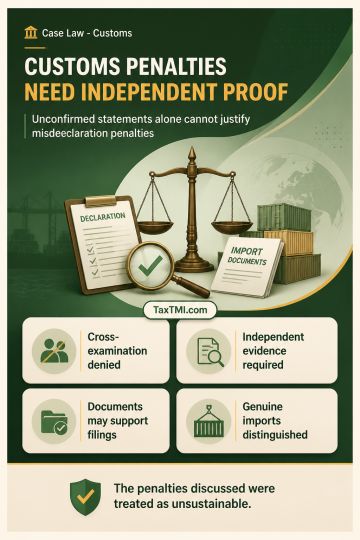
Cross-examination rights and corroborated evidence limit customs penalties for misdeclaration in genuine import transactions involving documented clea...
Page of 4782
Press 'Enter' after typing page number.
301 to 320 of 95636 Results
❮
❯
❯❯
0 / 200
Expand Note
Add to Folder
No Folders have been created
+
Are you sure you want to delete "My most important" ?
The Supreme Court of India examined the legality of the arrest of the petitioner under the Prevention of Money Laundering Act (PMLA) and the Unlawful Activities (Prevention) Act (UAPA). The Court found no significant difference between the provisions of Section 19 of the PMLA and Section 43B of the UAPA regarding the communication of grounds for arrest. Both provisions stem from the constitutional safeguard under Article 22(1) of the Indian Constitution. The Court emphasized the fundamental right of an arrested person to be informed in writing of the grounds for arrest promptly. Failure to provide written grounds of arrest before remand vitiates the arrest and subsequent proceedings. The Court held that the arrest and remand orders were invalid, quashed them, and directed the release of the appellant. The judgment sets a binding precedent for all courts in the country.
The Supreme Court of India examined the legality of the arrest of the petitioner under the Prevention of Money Laundering Act (PMLA) and the Unlawful Activities (Prevention) Act (UAPA). The Court found no significant difference between the provisions of Section 19 of the PMLA and Section 43B of the UAPA regarding the communication of grounds for arrest. Both provisions stem from the constitutional safeguard under Article 22(1) of the Indian Constitution. The Court emphasized the fundamental right of an arrested person to be informed in writing of the grounds for arrest promptly. Failure to provide written grounds of arrest before remand vitiates the arrest and subsequent proceedings. The Court held that the arrest and remand orders were invalid, quashed them, and directed the release of the appellant. The judgment sets a binding precedent for all courts in the country.
Note: It is a system-generated summary and is for quick reference only.
 TaxTMI
 of 4782




















 Join Channel


 TaxTMI