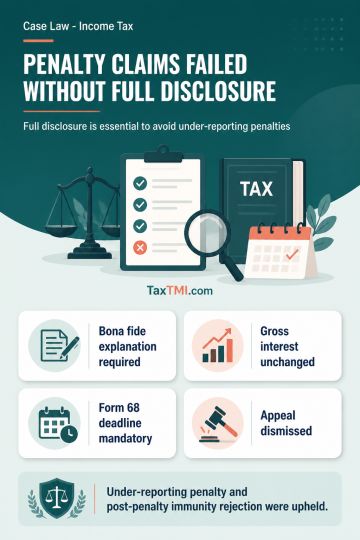
Bona fide disclosure requirements govern under-reporting penalties, and post-penalty immunity applications cannot secure available statutory protectio...
Certificate-of-origin verification procedure governs preferential customs benefits; denial without retroactive verification was set aside with consequ...
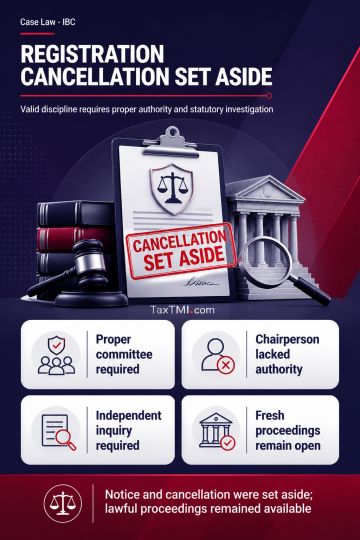
Disciplinary Committee jurisdiction and mandatory investigation requirements invalidated cancellation of an insolvency professional's registration and...
Retention of seized property survives where recorded reasons support proceeds of crime, while stayed investigation periods are excluded from limitatio...
The ITAT Mumbai addressed two key issues in the case. Firstly, regarding the penalty u/s 271(1)(c), the tribunal held that the absence of a tick mark on the notice did not prejudice the assessee as they were fully aware of the reasons for penalty initiation. The tribunal emphasized that the assessee actively participated in the proceedings and responded to the notice adequately. Citing the Veena Textiles case, the tribunal dismissed the argument that the defective notice provided grounds for relief.Secondly, concerning the penalty imposed on the estimation of income from bogus purchases, the tribunal ruled in favor of the assessee. It highlighted that when additions are based on estimates, as in this case where a percentage of bogus purchases was added, penalty u/s 271(1)(c) is not sustainable. The tribunal noted that since the purchases were paid through legitimate channels and there were corresponding sales, applying an ad hoc GP rate on alleged bogus purchases does not warrant a p
The ITAT Mumbai addressed two key issues in the case. Firstly, regarding the penalty u/s 271(1)(c), the tribunal held that the absence of a tick mark on the notice did not prejudice the assessee as they were fully aware of the reasons for penalty initiation. The tribunal emphasized that the assessee actively participated in the proceedings and responded to the notice adequately. Citing the Veena Textiles case, the tribunal dismissed the argument that the defective notice provided grounds for relief.Secondly, concerning the penalty imposed on the estimation of income from bogus purchases, the tribunal ruled in favor of the assessee. It highlighted that when additions are based on estimates, as in this case where a percentage of bogus purchases was added, penalty u/s 271(1)(c) is not sustainable. The tribunal noted that since the purchases were paid through legitimate channels and there were corresponding sales, applying an ad hoc GP rate on alleged bogus purchases does not warrant a p
Note: It is a system-generated summary and is for quick reference only.
 TaxTMI
 of 4792


















 Join Channel


 TaxTMI
