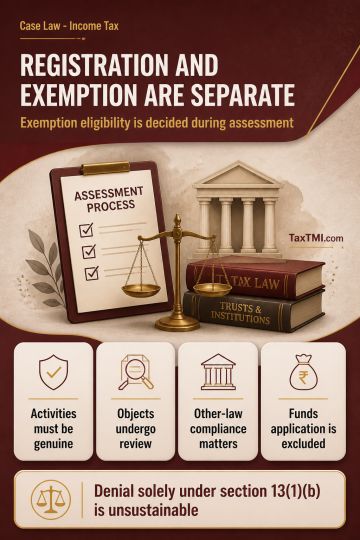
Defined public benefit can retain charitable character; registration renewal requires examining genuine activities and legal compliance, not surplus a...
Capital reduction is distinct from share buy-back, preventing buy-back tax; restructuring interest and related business deductions also survive scruti...
Transfer pricing and tax deductions upheld on established principles, while employee contributions and warranty provisions returned for fresh examinat...
Captive transfer pricing relies on industrial consumer tariffs, while genuine quotations can benchmark effluent treatment transfers under the Other Me...
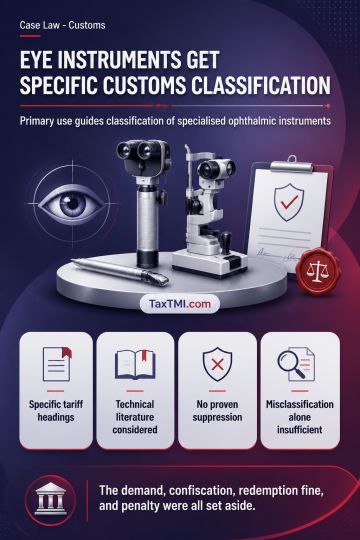
Specific tariff classification for ophthalmic instruments and extended limitation principles determine the treatment of duty demands, confiscation, an...
Page of 4801
Press 'Enter' after typing page number.
1161 to 1180 of 96001 Results
❮
❯
❯❯
0 / 200
Expand Note
Add to Folder
No Folders have been created
+
Are you sure you want to delete "My most important" ?
In the case of 2024 (5) TMI 1099 before ITAT Mumbai, the issue was the validity of a reassessment order. The CIT (A) passed an order that contained different grounds than those raised by the assessee, indicating a lack of independent application of mind. The assessment order referred to in the caption did not match the one in the body of the order. The facts in the assessment order differed from those mentioned by the CIT (A). The grounds of appeal were also different between what the assessee submitted and what the CIT (A) included in the order. The ITAT found the CIT (A) had engaged in a 'cut & paste' exercise without proper consideration, leading to an unsustainable and perverse order. Consequently, the ITAT allowed all grounds of appeal, directing the CIT (A) to reconsider the case based on the actual facts and provide the assessee with a fair hearing. The appeal of the AO was allowed.
In the case of 2024 (5) TMI 1099 before ITAT Mumbai, the issue was the validity of a reassessment order. The CIT (A) passed an order that contained different grounds than those raised by the assessee, indicating a lack of independent application of mind. The assessment order referred to in the caption did not match the one in the body of the order. The facts in the assessment order differed from those mentioned by the CIT (A). The grounds of appeal were also different between what the assessee submitted and what the CIT (A) included in the order. The ITAT found the CIT (A) had engaged in a 'cut & paste' exercise without proper consideration, leading to an unsustainable and perverse order. Consequently, the ITAT allowed all grounds of appeal, directing the CIT (A) to reconsider the case based on the actual facts and provide the assessee with a fair hearing. The appeal of the AO was allowed.
Note: It is a system-generated summary and is for quick reference only.
 TaxTMI
 of 4801
















 Join Channel


 TaxTMI