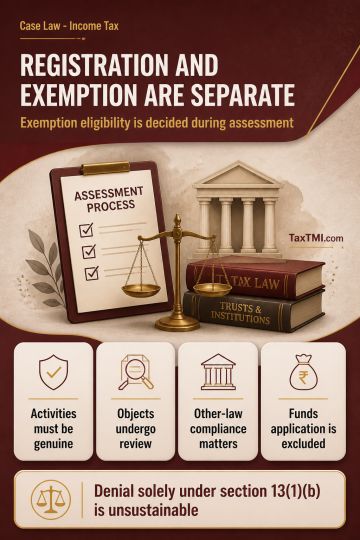
Defined public benefit can retain charitable character; registration renewal requires examining genuine activities and legal compliance, not surplus a...
Capital reduction is distinct from share buy-back, preventing buy-back tax; restructuring interest and related business deductions also survive scruti...
Transfer pricing and tax deductions upheld on established principles, while employee contributions and warranty provisions returned for fresh examinat...
Captive transfer pricing relies on industrial consumer tariffs, while genuine quotations can benchmark effluent treatment transfers under the Other Me...
Specific tariff classification for ophthalmic instruments and extended limitation principles determine the treatment of duty demands, confiscation, an...
Page of 4801
Press 'Enter' after typing page number.
1161 to 1180 of 96001 Results
❮
❯
❯❯
0 / 200
Expand Note
Add to Folder
No Folders have been created
+
Are you sure you want to delete "My most important" ?
In the case before ITAT Mumbai, the issue revolved around the deduction u/s 80G for a charitable trust. The assessee, now assessable as an AOP, had donated an amount exceeding 10% of its gross total income to an approved educational institution. The CIT(A) held that Section 80G(4) does not restrict donations to 10% of total income, allowing 50% deduction. The matter was remanded to verify deductions for entities u/s 80G(3)(a)(iiif). The Tribunal upheld this decision, dismissing the appeal. Additionally, the claim for deduction u/s 80GGA, though not separately mentioned in the return, was considered valid as it was included under Chapter VIA. Lastly, disallowance of carry forward of excess expenditure was deemed irrelevant as the assessee did not claim benefits u/s 11 and 12.
In the case before ITAT Mumbai, the issue revolved around the deduction u/s 80G for a charitable trust. The assessee, now assessable as an AOP, had donated an amount exceeding 10% of its gross total income to an approved educational institution. The CIT(A) held that Section 80G(4) does not restrict donations to 10% of total income, allowing 50% deduction. The matter was remanded to verify deductions for entities u/s 80G(3)(a)(iiif). The Tribunal upheld this decision, dismissing the appeal. Additionally, the claim for deduction u/s 80GGA, though not separately mentioned in the return, was considered valid as it was included under Chapter VIA. Lastly, disallowance of carry forward of excess expenditure was deemed irrelevant as the assessee did not claim benefits u/s 11 and 12.
Note: It is a system-generated summary and is for quick reference only.
 TaxTMI
 of 4801



















 Join Channel


 TaxTMI

