Defined public benefit can retain charitable character; registration renewal requires examining genuine activities and legal compliance, not surplus a...
Capital reduction is distinct from share buy-back, preventing buy-back tax; restructuring interest and related business deductions also survive scruti...
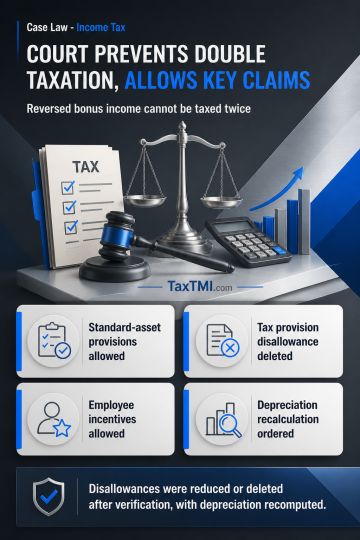
Transfer pricing and tax deductions upheld on established principles, while employee contributions and warranty provisions returned for fresh examinat...
Captive transfer pricing relies on industrial consumer tariffs, while genuine quotations can benchmark effluent treatment transfers under the Other Me...
Specific tariff classification for ophthalmic instruments and extended limitation principles determine the treatment of duty demands, confiscation, an...
Integrated golf function determines classification, placing launch monitors and simulators under other golf equipment rather than measuring instrument...
The Madhya Pradesh High Court examined the scope of judicial review u/s 212(1)(c) of the Companies Act, 2013 regarding the Central Government's sanction for an investigation by the SFIO. The court held that SFIO investigation on transactions already addressed u/s 66 of the IBC would amount to double jeopardy. It emphasized the necessity of public interest for such investigations and found no such element in this case. The court noted that the company's functions were halted due to CIRP and pending liquidation, indicating no public interest or prima facie case for the investigation. The court ruled the sanction as arbitrary, illegal, and lacking a reasoned order, thus setting it aside and quashing any actions taken based on it.
The Madhya Pradesh High Court examined the scope of judicial review u/s 212(1)(c) of the Companies Act, 2013 regarding the Central Government's sanction for an investigation by the SFIO. The court held that SFIO investigation on transactions already addressed u/s 66 of the IBC would amount to double jeopardy. It emphasized the necessity of public interest for such investigations and found no such element in this case. The court noted that the company's functions were halted due to CIRP and pending liquidation, indicating no public interest or prima facie case for the investigation. The court ruled the sanction as arbitrary, illegal, and lacking a reasoned order, thus setting it aside and quashing any actions taken based on it.
Note: It is a system-generated summary and is for quick reference only.
 TaxTMI
 of 4807
















 Join Channel


 TaxTMI
