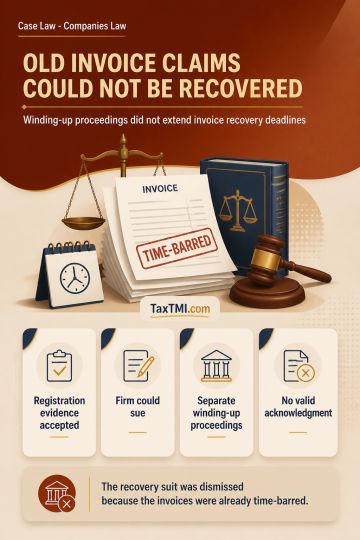
Invoice-based recovery claims remain time-barred despite separate winding-up proceedings, absent valid acknowledgment or part-payment of the disputed ...
Extended limitation fails without specific suppression allegations, while overseas employee secondment remains taxable as manpower supply within norma...
Time-share accommodation classification excludes Club or Association Service where purchasers receive contractual occupancy rights without genuine mem...
CENVAT credit for trading requires reversal, while taxable-service rental credit remains proportionately available and limitation issues await resolut...
Vicarious liability for dishonoured company cheques may extend to non-signatory directors where complaints contain foundational responsibility avermen...
The Madhya Pradesh High Court examined the scope of judicial review u/s 212(1)(c) of the Companies Act, 2013 regarding the Central Government's sanction for an investigation by the SFIO. The court held that SFIO investigation on transactions already addressed u/s 66 of the IBC would amount to double jeopardy. It emphasized the necessity of public interest for such investigations and found no such element in this case. The court noted that the company's functions were halted due to CIRP and pending liquidation, indicating no public interest or prima facie case for the investigation. The court ruled the sanction as arbitrary, illegal, and lacking a reasoned order, thus setting it aside and quashing any actions taken based on it.
The Madhya Pradesh High Court examined the scope of judicial review u/s 212(1)(c) of the Companies Act, 2013 regarding the Central Government's sanction for an investigation by the SFIO. The court held that SFIO investigation on transactions already addressed u/s 66 of the IBC would amount to double jeopardy. It emphasized the necessity of public interest for such investigations and found no such element in this case. The court noted that the company's functions were halted due to CIRP and pending liquidation, indicating no public interest or prima facie case for the investigation. The court ruled the sanction as arbitrary, illegal, and lacking a reasoned order, thus setting it aside and quashing any actions taken based on it.
Note: It is a system-generated summary and is for quick reference only.
 TaxTMI
 of 4803














 Join Channel


 TaxTMI