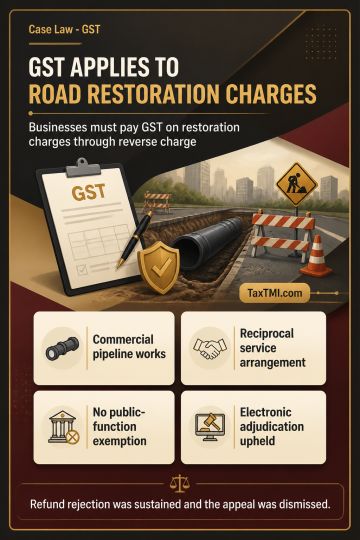
Request-driven road restoration attracts reverse-charge GST, not governmental-function treatment or compensatory-damages status for business recipient...
Road restoration charges for commercial pipeline works are taxable Government services, with reverse charge liability and no public-function exemption...
Model-wise import cap monitoring cannot justify withholding used multifunction machines where all-India tracking is absent and full security is furnis...
The ITAT Hyderabad addressed a Transfer Pricing (TP) Adjustment issue regarding interest on outstanding receivables, determining if it constitutes an international transaction. Referring to the amendment to Section 92B of the Act by the Finance Act, 2012, the Tribunal held that interest on outstanding receivables is indeed an international transaction requiring separate benchmarking. The Tribunal noted that the DRP directed the AO to use the SBI short-term deposit interest rate as the Arm's Length Price (ALP) interest rate and adjust income based on a credit period of thirty days or as per the agreement/invoice. The Tribunal directed the AO/TPO to compute the interest rate on similar foreign currency receivables/advances as LIBOR+200 points, applying the appropriate credit period. The Tribunal allowed the grounds in part, emphasizing the need for accurate computation and adherence to the specified credit period.
The ITAT Hyderabad addressed a Transfer Pricing (TP) Adjustment issue regarding interest on outstanding receivables, determining if it constitutes an international transaction. Referring to the amendment to Section 92B of the Act by the Finance Act, 2012, the Tribunal held that interest on outstanding receivables is indeed an international transaction requiring separate benchmarking. The Tribunal noted that the DRP directed the AO to use the SBI short-term deposit interest rate as the Arm's Length Price (ALP) interest rate and adjust income based on a credit period of thirty days or as per the agreement/invoice. The Tribunal directed the AO/TPO to compute the interest rate on similar foreign currency receivables/advances as LIBOR+200 points, applying the appropriate credit period. The Tribunal allowed the grounds in part, emphasizing the need for accurate computation and adherence to the specified credit period.
Note: It is a system-generated summary and is for quick reference only.
 TaxTMI
  TaxTMI
 of 4918