Statutory transfer formalities invalidated alleged share and property transfers, while retrospective record manipulation constituted oppression and mi...
Provisional attachment of laundered funds and equivalent-value property sustained, with statutory protection limited to pension, gratuity and providen...
Insolvency moratorium does not shield company officers from cheque dishonour prosecution for liability arising before corporate insolvency proceedings...
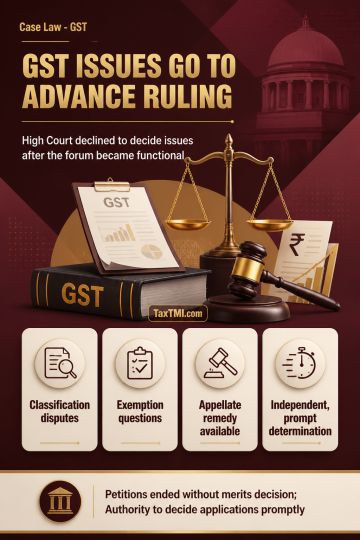
Advance-ruling mechanism governs pending GST classification, exemption and taxability disputes, limiting writ review once the specialised forum functi...
Page of 4805
Press 'Enter' after typing page number.
921 to 940 of 96092 Results
❮
❯
❯❯
0 / 200
Expand Note
Add to Folder
No Folders have been created
+
Are you sure you want to delete "My most important" ?
The ITAT Hyderabad addressed a Transfer Pricing (TP) Adjustment issue regarding interest on outstanding receivables, determining if it constitutes an international transaction. Referring to the amendment to Section 92B of the Act by the Finance Act, 2012, the Tribunal held that interest on outstanding receivables is indeed an international transaction requiring separate benchmarking. The Tribunal noted that the DRP directed the AO to use the SBI short-term deposit interest rate as the Arm's Length Price (ALP) interest rate and adjust income based on a credit period of thirty days or as per the agreement/invoice. The Tribunal directed the AO/TPO to compute the interest rate on similar foreign currency receivables/advances as LIBOR+200 points, applying the appropriate credit period. The Tribunal allowed the grounds in part, emphasizing the need for accurate computation and adherence to the specified credit period.
The ITAT Hyderabad addressed a Transfer Pricing (TP) Adjustment issue regarding interest on outstanding receivables, determining if it constitutes an international transaction. Referring to the amendment to Section 92B of the Act by the Finance Act, 2012, the Tribunal held that interest on outstanding receivables is indeed an international transaction requiring separate benchmarking. The Tribunal noted that the DRP directed the AO to use the SBI short-term deposit interest rate as the Arm's Length Price (ALP) interest rate and adjust income based on a credit period of thirty days or as per the agreement/invoice. The Tribunal directed the AO/TPO to compute the interest rate on similar foreign currency receivables/advances as LIBOR+200 points, applying the appropriate credit period. The Tribunal allowed the grounds in part, emphasizing the need for accurate computation and adherence to the specified credit period.
Note: It is a system-generated summary and is for quick reference only.
 TaxTMI
 of 4805














 Join Channel


 TaxTMI