Specified regulatory authority income receives conditional tax exemption, subject to non-commercial activity, unchanged income character, and return f...
Tax exemption for regulatory authority income applies retrospectively, subject to non-commercial activity, unchanged income sources, and return-filing...
Input tax credit conditions remain constitutionally valid, with eligible recipient claims considered under GST circulars and retrospective filing dead...
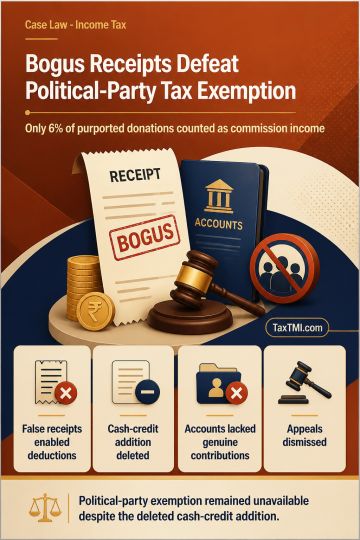
Bogus donation receipts justified commission income assessment and defeated political-party tax exemption for inaccurate accounts and reporting failur...
Pure reimbursement without income element escapes tax withholding, while delayed withholding and unsupported provisions face deferred or renewed scrut...
Public benefit requirement defeats charitable registration where residents' association services are reciprocal, member-only facilities governed by mu...
The ITAT Hyderabad held that the capital asset, as defined in section 2(14) of the Act, must be held by the assessee and not connected with their business or profession. In this case, the land in question was owned and registered in the name of A. Vindhyavali, not the assessee. Therefore, it was not a capital asset in the hands of the assessee, and no addition could be made for capital gains arising from its sale. The AO's reliance on sale deeds was justified as the AO mentioned them in relation to the agricultural land and the sale cum GPA entered by the assessee. The CIT(A) granted relief based on registered documents, which are admissible in law as "documents in rem." The decision was made in accordance with the Transfer of Property Act and did not violate principles of natural justice or Rule 46A of the IT Rules. The deletion of the addition towards capital gains from the land sale was upheld, ruling in favor of the assessee.
The ITAT Hyderabad held that the capital asset, as defined in section 2(14) of the Act, must be held by the assessee and not connected with their business or profession. In this case, the land in question was owned and registered in the name of A. Vindhyavali, not the assessee. Therefore, it was not a capital asset in the hands of the assessee, and no addition could be made for capital gains arising from its sale. The AO's reliance on sale deeds was justified as the AO mentioned them in relation to the agricultural land and the sale cum GPA entered by the assessee. The CIT(A) granted relief based on registered documents, which are admissible in law as "documents in rem." The decision was made in accordance with the Transfer of Property Act and did not violate principles of natural justice or Rule 46A of the IT Rules. The deletion of the addition towards capital gains from the land sale was upheld, ruling in favor of the assessee.
Note: It is a system-generated summary and is for quick reference only.
 TaxTMI
 of 4805



















 Join Channel


 TaxTMI