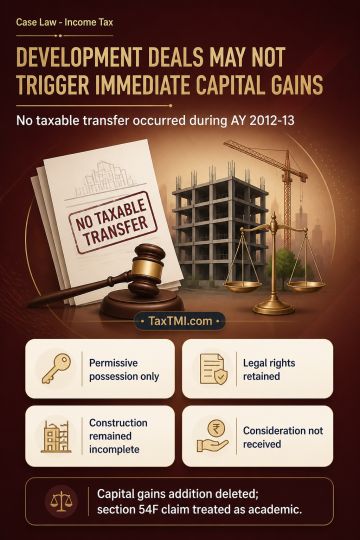
Development agreements require legal possession or effective enjoyment for capital gains transfer; permissive possession and deferred consideration de...
Prolonged sterilisation of development rights supports capital-gains treatment, while business-income disallowances cannot govern capital-gains comput...
Additional evidence in transfer pricing dispute leads to fresh examination, while tax deductions, TDS credit, fee and refund interest require verifica...
Category II AIF pass-through taxation preserves non-business income character; investment receipts cannot be reclassified without applying recognised ...
The ITAT Jodhpur dealt with a case involving addition u/s 68 of the Income Tax Act concerning alleged bogus share application money. The Investigation Wing provided specific information, but the CIT(A) deleted the addition after finding the investor companies' identity, creditworthiness, and genuineness were proven by the assessee. The tribunal upheld the CIT(A)'s decision, stating the AO lacked a basis for the addition. The commission expenses for the alleged bogus share application money were deemed unnecessary due to the genuine nature of the funds. The reassessment proceedings' validity was not directly addressed by the CIT(A) but was considered decided against the assessee based on a legal precedent. The tribunal allowed the assessee to argue the reassessment issue despite not appealing the CIT(A)'s decision, in line with ITAT Rules.
The ITAT Jodhpur dealt with a case involving addition u/s 68 of the Income Tax Act concerning alleged bogus share application money. The Investigation Wing provided specific information, but the CIT(A) deleted the addition after finding the investor companies' identity, creditworthiness, and genuineness were proven by the assessee. The tribunal upheld the CIT(A)'s decision, stating the AO lacked a basis for the addition. The commission expenses for the alleged bogus share application money were deemed unnecessary due to the genuine nature of the funds. The reassessment proceedings' validity was not directly addressed by the CIT(A) but was considered decided against the assessee based on a legal precedent. The tribunal allowed the assessee to argue the reassessment issue despite not appealing the CIT(A)'s decision, in line with ITAT Rules.
Note: It is a system-generated summary and is for quick reference only.
 TaxTMI
 of 4805













 Join Channel


 TaxTMI
