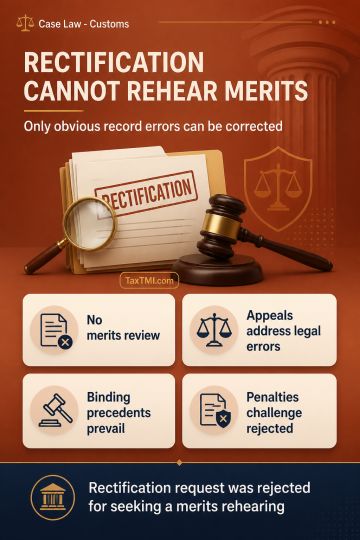
Rectification of mistake remains limited to self-evident record errors, preventing merits review through miscellaneous applications and preserving fin...
Tender creditworthiness conditions may extend to de facto Promoter Directors, with post-participation challenges generally barred absent arbitrariness...
Corporate representation in PMLA summons proceedings permitted through an authorised signatory, subject to directors' continuing cooperation and atten...
Helicopter charter classification requires effective control analysis, while territorial performance, reasoned credit orders and wilful suppression de...
Specified fund definition expands PAN exemption eligibility for registered alternative investment funds and qualifying International Financial Service...
Tax exemption for specified legal-services authority income applies retrospectively, subject to non-commercial activity, unchanged income sources, and...
The case before CESTAT Bangalore involved the interpretation of an exemption notification u/s 12/2012-CE for Additional Duty. The issue was whether a "Grid-Tied Solar Inverter" could be considered a "Solar Power Generating System" for claiming the exemption. The Tribunal held that while the inverter is used in a solar system, it does not constitute the entire system. The respondent failed to satisfy the conditions of the notification, thus not eligible for the exemption. The Commissioner's view of liberal interpretation was rejected, citing the burden of proof on the Revenue. The decision was in line with the Supreme Court's ruling in Dilip Kumar and Company case. The impugned order was set aside, and the appeal was allowed.
The case before CESTAT Bangalore involved the interpretation of an exemption notification u/s 12/2012-CE for Additional Duty. The issue was whether a "Grid-Tied Solar Inverter" could be considered a "Solar Power Generating System" for claiming the exemption. The Tribunal held that while the inverter is used in a solar system, it does not constitute the entire system. The respondent failed to satisfy the conditions of the notification, thus not eligible for the exemption. The Commissioner's view of liberal interpretation was rejected, citing the burden of proof on the Revenue. The decision was in line with the Supreme Court's ruling in Dilip Kumar and Company case. The impugned order was set aside, and the appeal was allowed.
Note: It is a system-generated summary and is for quick reference only.
 TaxTMI
 of 4803



















 Join Channel


 TaxTMI