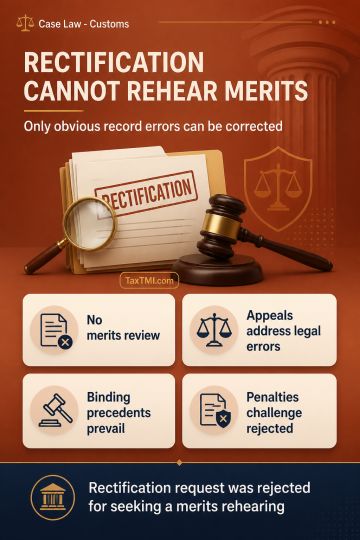
Rectification of mistake remains limited to self-evident record errors, preventing merits review through miscellaneous applications and preserving fin...
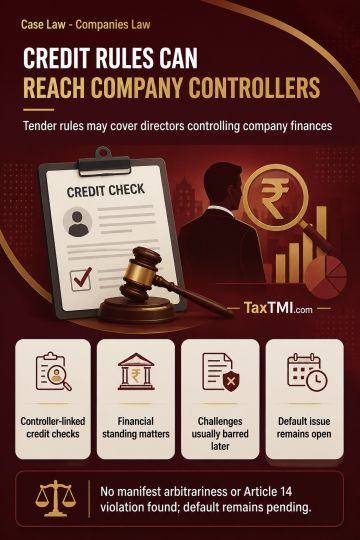
Tender creditworthiness conditions may extend to de facto Promoter Directors, with post-participation challenges generally barred absent arbitrariness...
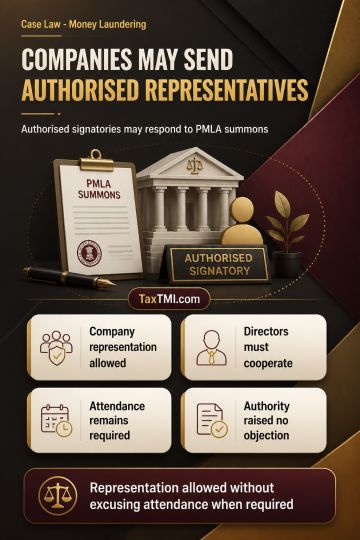
Corporate representation in PMLA summons proceedings permitted through an authorised signatory, subject to directors' continuing cooperation and atten...
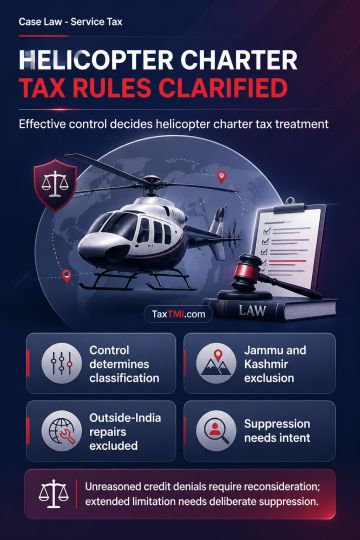
Helicopter charter classification requires effective control analysis, while territorial performance, reasoned credit orders and wilful suppression de...
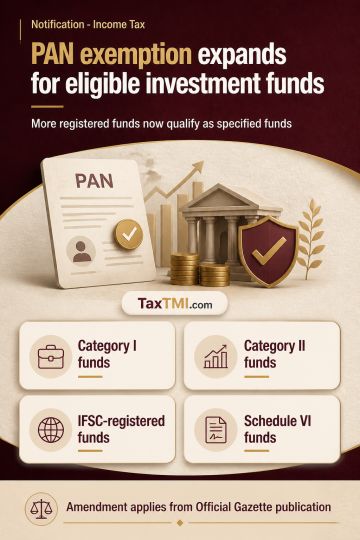
Specified fund definition expands PAN exemption eligibility for registered alternative investment funds and qualifying International Financial Service...
Page of 4794
Press 'Enter' after typing page number.
741 to 760 of 95875 Results
❮
❯
❯❯
0 / 200
Expand Note
Add to Folder
No Folders have been created
+
Are you sure you want to delete "My most important" ?
The ITAT Chennai ruled on deduction u/s 80IA, focusing on determining the market value of power supplied by the assessee to its industrial units. The AO argued for using rates fixed by Tariff Regulatory Commission, while the assessee supported using the average price of power purchased. The Supreme Court clarified that "market value" refers to the price in a free trade environment. It held that the market value should be based on the rate at which the State Electricity Board supplied power to consumers, not the rate sold to a supplier. The ITAT noted that the AO allowed the deduction for the initial year and subsequent years. The assessee used a price of ₹5.60 per unit based on charges paid to Tamilnadu Electricity Board. Ultimately, the ITAT held that the State Electricity Board's rate should be considered the market value for claiming deduction u/s 80IA, dismissing the Revenue's grounds.
The ITAT Chennai ruled on deduction u/s 80IA, focusing on determining the market value of power supplied by the assessee to its industrial units. The AO argued for using rates fixed by Tariff Regulatory Commission, while the assessee supported using the average price of power purchased. The Supreme Court clarified that "market value" refers to the price in a free trade environment. It held that the market value should be based on the rate at which the State Electricity Board supplied power to consumers, not the rate sold to a supplier. The ITAT noted that the AO allowed the deduction for the initial year and subsequent years. The assessee used a price of ₹5.60 per unit based on charges paid to Tamilnadu Electricity Board. Ultimately, the ITAT held that the State Electricity Board's rate should be considered the market value for claiming deduction u/s 80IA, dismissing the Revenue's grounds.
Note: It is a system-generated summary and is for quick reference only.
 TaxTMI
 of 4794






 Join Channel


 TaxTMI