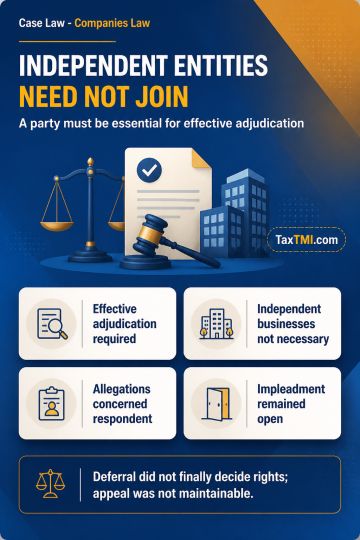
Necessary-party requirements limit impleadment of independent entities, while deferred consideration does not create an appealable adverse determinati...
Food supplement classification requires common parlance and authoritative tests, preventing treatment as proprietary Ayurvedic medicines without suppo...
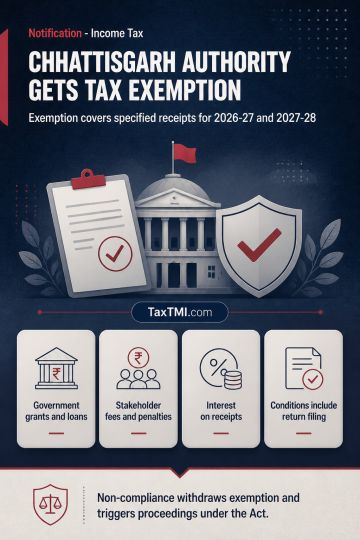
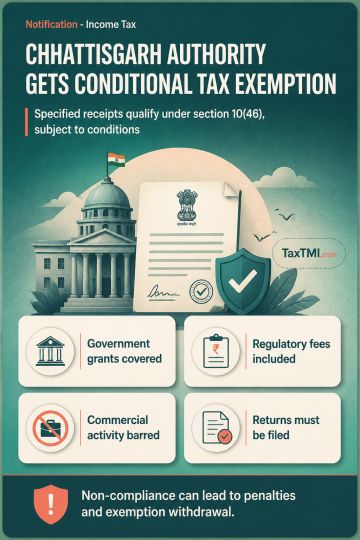
Specified regulatory authority income receives conditional tax exemption, subject to non-commercial activity, unchanged income character, and return f...
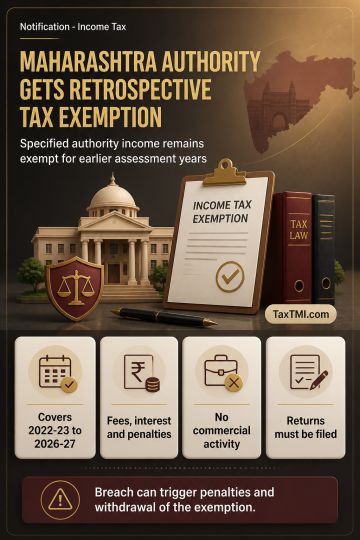
Tax exemption for regulatory authority income applies retrospectively, subject to non-commercial activity, unchanged income sources, and return-filing...
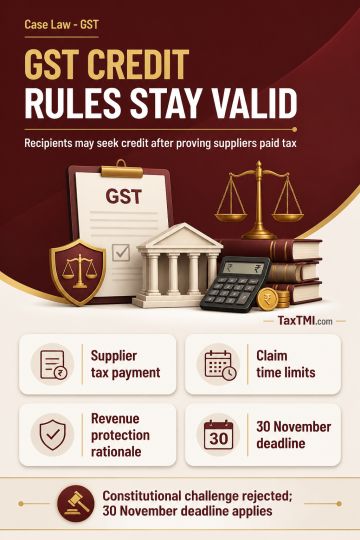
Input tax credit conditions remain constitutionally valid, with eligible recipient claims considered under GST circulars and retrospective filing dead...
The ITAT Chennai ruled on deduction u/s 80IA, focusing on determining the market value of power supplied by the assessee to its industrial units. The AO argued for using rates fixed by Tariff Regulatory Commission, while the assessee supported using the average price of power purchased. The Supreme Court clarified that "market value" refers to the price in a free trade environment. It held that the market value should be based on the rate at which the State Electricity Board supplied power to consumers, not the rate sold to a supplier. The ITAT noted that the AO allowed the deduction for the initial year and subsequent years. The assessee used a price of ₹5.60 per unit based on charges paid to Tamilnadu Electricity Board. Ultimately, the ITAT held that the State Electricity Board's rate should be considered the market value for claiming deduction u/s 80IA, dismissing the Revenue's grounds.
The ITAT Chennai ruled on deduction u/s 80IA, focusing on determining the market value of power supplied by the assessee to its industrial units. The AO argued for using rates fixed by Tariff Regulatory Commission, while the assessee supported using the average price of power purchased. The Supreme Court clarified that "market value" refers to the price in a free trade environment. It held that the market value should be based on the rate at which the State Electricity Board supplied power to consumers, not the rate sold to a supplier. The ITAT noted that the AO allowed the deduction for the initial year and subsequent years. The assessee used a price of ₹5.60 per unit based on charges paid to Tamilnadu Electricity Board. Ultimately, the ITAT held that the State Electricity Board's rate should be considered the market value for claiming deduction u/s 80IA, dismissing the Revenue's grounds.
Note: It is a system-generated summary and is for quick reference only.
 TaxTMI
 of 4792







 Join Channel


 TaxTMI