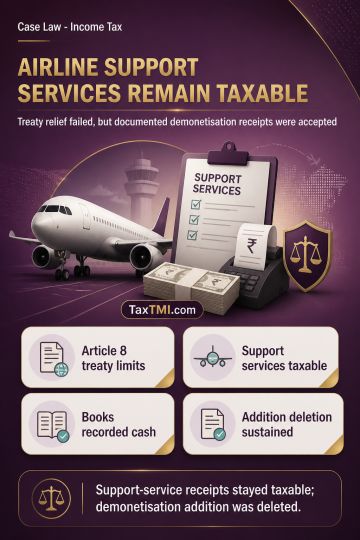
Article 8 treaty coverage excluded third-party airline support services, while documented demonetisation cash receipts remained accepted business inco...
Functional comparability under TNMM requires highway contract benchmarks to reflect operation, maintenance and transfer activities, requiring fresh be...
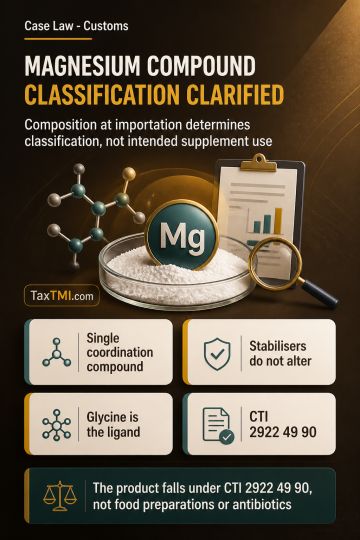
Objective characteristics govern magnesium bis-glycinate chelate classification as an amino-acid coordination compound, not a food preparation or anti...
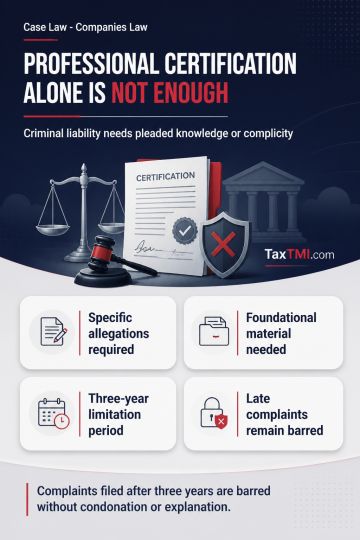
Independent professional certification requires pleaded knowledge or complicity for criminal liability; untimely complaints remain barred by limitatio...
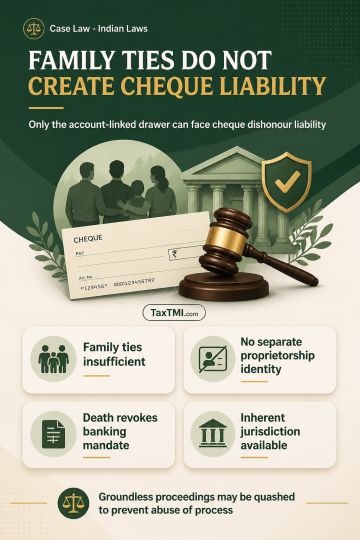
The High Court considered a case involving dishonour of cheque and cheating allegations u/s 138 of N.I. Act and u/s 420 IPC. The court found that there was no evidence of dishonest intention at the inception of the transaction, leading to the conclusion that the issuance of a cheque from a closed account did not establish the essential element of dishonest intention u/s 420 IPC. The court noted that the legal notice was premature, as the complainant could still file a fresh complaint u/s 138 of N.I. Act within two months. The conviction and sentence u/s 420 IPC and u/s 138 of N.I. Act were set aside, allowing for the possibility of a fresh complaint.
The High Court considered a case involving dishonour of cheque and cheating allegations u/s 138 of N.I. Act and u/s 420 IPC. The court found that there was no evidence of dishonest intention at the inception of the transaction, leading to the conclusion that the issuance of a cheque from a closed account did not establish the essential element of dishonest intention u/s 420 IPC. The court noted that the legal notice was premature, as the complainant could still file a fresh complaint u/s 138 of N.I. Act within two months. The conviction and sentence u/s 420 IPC and u/s 138 of N.I. Act were set aside, allowing for the possibility of a fresh complaint.
Note: It is a system-generated summary and is for quick reference only.
 TaxTMI
 of 4800







 Join Channel


 TaxTMI
