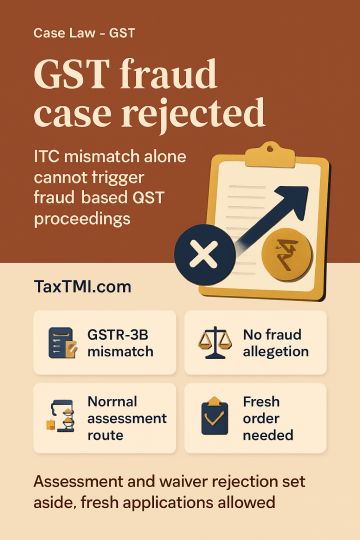
Fraud-based GST assessment cannot stand without allegations of fraud, wilful misstatement or suppression; proceedings must follow normal classificatio...
Page of 4805
Press 'Enter' after typing page number.
1341 to 1360 of 96092 Results
❮
❯
❯❯
0 / 200
Expand Note
Add to Folder
No Folders have been created
+
Are you sure you want to delete "My most important" ?
In the ITAT Jaipur case, the issue revolved around a revision u/s 263 by CIT concerning the assessee's case under limited scrutiny u/s 143(3). The primary focus was on payments to specified persons and a percentage disallowance on salary payments. The tribunal held that the AO had conducted inquiries and verified details submitted by the assessee, allowing the salary payments. The observations by the PCIT were based on a different assessment year, and a disallowance in one year cannot be the basis for doubting claims in another year. The tribunal concluded that the revision proceedings by the PCIT were beyond jurisdiction and against legal principles, quashing the order u/s 263 and allowing the assessee's appeal.
In the ITAT Jaipur case, the issue revolved around a revision u/s 263 by CIT concerning the assessee's case under limited scrutiny u/s 143(3). The primary focus was on payments to specified persons and a percentage disallowance on salary payments. The tribunal held that the AO had conducted inquiries and verified details submitted by the assessee, allowing the salary payments. The observations by the PCIT were based on a different assessment year, and a disallowance in one year cannot be the basis for doubting claims in another year. The tribunal concluded that the revision proceedings by the PCIT were beyond jurisdiction and against legal principles, quashing the order u/s 263 and allowing the assessee's appeal.
Note: It is a system-generated summary and is for quick reference only.
 TaxTMI
 of 4805
















 Join Channel


 TaxTMI