Business expenditure deduction requires proof of genuine commission payments and commercial allowability; turnover growth alone cannot validate the cl...
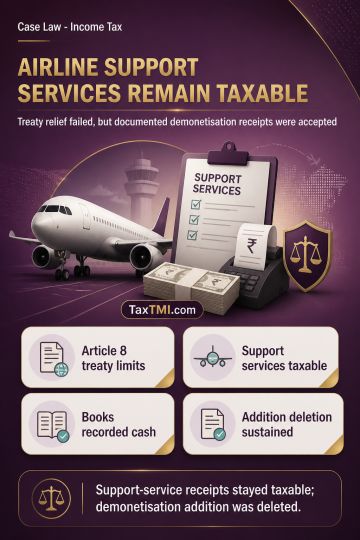
Article 8 treaty coverage excluded third-party airline support services, while documented demonetisation cash receipts remained accepted business inco...
Functional comparability under TNMM requires highway contract benchmarks to reflect operation, maintenance and transfer activities, requiring fresh be...
In the ITAT Jaipur case, the issue revolved around a revision u/s 263 by CIT concerning the assessee's case under limited scrutiny u/s 143(3). The primary focus was on payments to specified persons and a percentage disallowance on salary payments. The tribunal held that the AO had conducted inquiries and verified details submitted by the assessee, allowing the salary payments. The observations by the PCIT were based on a different assessment year, and a disallowance in one year cannot be the basis for doubting claims in another year. The tribunal concluded that the revision proceedings by the PCIT were beyond jurisdiction and against legal principles, quashing the order u/s 263 and allowing the assessee's appeal.
In the ITAT Jaipur case, the issue revolved around a revision u/s 263 by CIT concerning the assessee's case under limited scrutiny u/s 143(3). The primary focus was on payments to specified persons and a percentage disallowance on salary payments. The tribunal held that the AO had conducted inquiries and verified details submitted by the assessee, allowing the salary payments. The observations by the PCIT were based on a different assessment year, and a disallowance in one year cannot be the basis for doubting claims in another year. The tribunal concluded that the revision proceedings by the PCIT were beyond jurisdiction and against legal principles, quashing the order u/s 263 and allowing the assessee's appeal.
Note: It is a system-generated summary and is for quick reference only.
 TaxTMI
 of 4792


















 Join Channel


 TaxTMI
