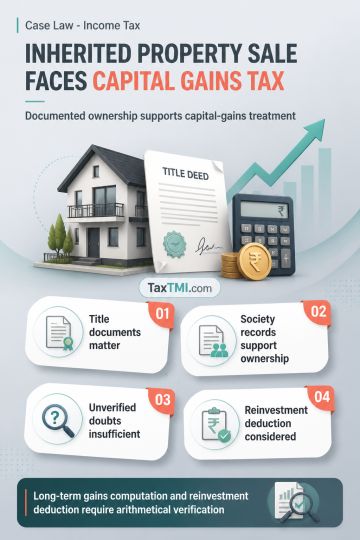
Inherited property sale proceeds require capital-gains treatment where ownership is supported by evidence, not suspicion or unverified signature doubt...
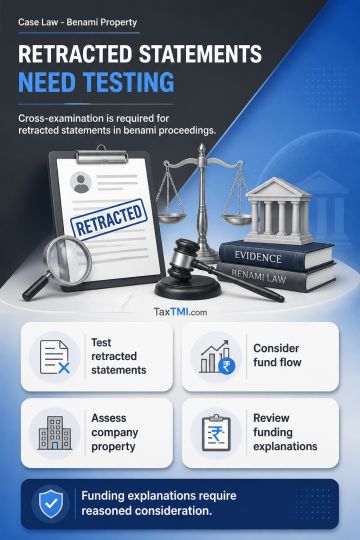
Cross-examination of retracted statements is essential where foundational evidence supports a benami allegation and documented funding explanations re...
Capital-goods exemption covers plant-modernisation accessories, while the import restriction applies only to earlier capital-goods components and spar...
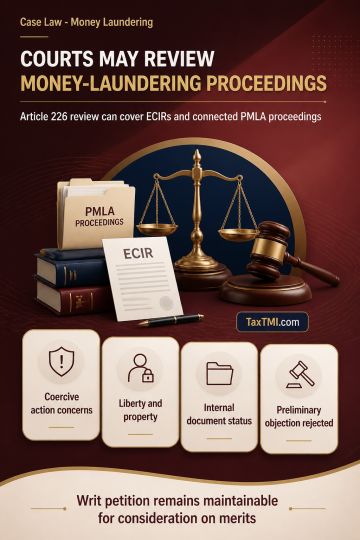
Constitutional judicial review permits challenges to ECIRs and connected money-laundering proceedings where coercive action affects fundamental intere...
Assessment made u/s 144 r.w.s. 142(1) OR 153C - The Tribunal held that the assessment made u/s 144 r.w.s. 142(1) for A.Y. 2012-13, based on the satisfaction recorded on 18.11.2013 (A.Y. 2014-15), should have been conducted u/s 153C of the Income Tax Act. The Tribunal referenced the judgments of the Hon’ble Delhi High Court and the Hon’ble Supreme Court, stating that the satisfaction note must explicitly indicate that the seized documents belong to the assessee. The Tribunal found that the assessments made were outside the scope of Section 153C, and hence, the assessment u/s 144 r.w.s. 142(1) was void ab initio.
Assessment made u/s 144 r.w.s. 142(1) OR 153C - The Tribunal held that the assessment made u/s 144 r.w.s. 142(1) for A.Y. 2012-13, based on the satisfaction recorded on 18.11.2013 (A.Y. 2014-15), should have been conducted u/s 153C of the Income Tax Act. The Tribunal referenced the judgments of the Hon’ble Delhi High Court and the Hon’ble Supreme Court, stating that the satisfaction note must explicitly indicate that the seized documents belong to the assessee. The Tribunal found that the assessments made were outside the scope of Section 153C, and hence, the assessment u/s 144 r.w.s. 142(1) was void ab initio.
Note: It is a system-generated summary and is for quick reference only.
 TaxTMI
 of 4805
















 Join Channel


 TaxTMI