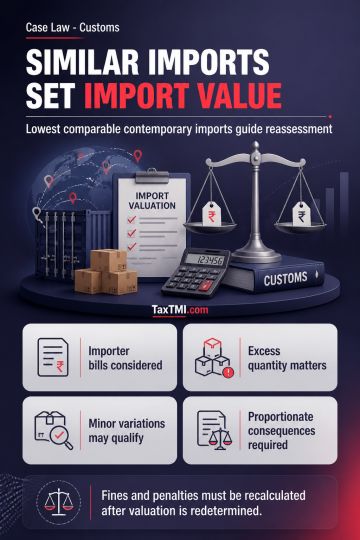
Customs valuation must use comparable contemporary imports, while confiscation fines and penalties require proportionate recalculation on reassessed v...
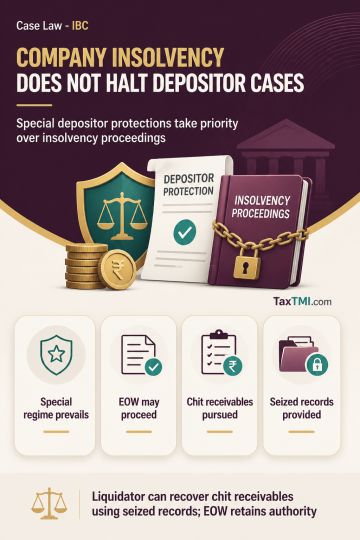
Depositor-protection proceedings prevail over corporate insolvency, while liquidators may recover chit receivables using copies of seized company reco...
Intermediary service classification fails where overseas admission facilitation is supplied independently, preserving export treatment and small-provi...
Satellite transponder bandwidth is telecommunication, not Business Support Service; foreign non-telegraph providers triggered no service tax liability...
Commitment proceedings gain extended timelines, structured defect refiling, and automatic resumption of inquiry after the adjusted completion period e...
Penalty u/s 271 (1) (c) - Income disclosed only after the search and seizure operation - The High Court emphasized that Explanation 5A of Section 271(1)(c) deems concealed income even if disclosed post-search, and upheld the assessing officer’s initiation of penalty proceedings based on detailed findings of concealed income in the assessment orders. The Court referenced key Supreme Court judgments, asserting that the satisfaction for penalty can be inferred from the assessment order and need not be explicitly stated in the notice if the order details the concealment. It also rejected the respondent’s defense of voluntary disclosure, noting it was made only after irrefutable evidence of concealment emerged during the search. It set aside the ITAT’s order, reinstated the penalties, and remanded the matter to the ITAT for adjudication on merits.
Penalty u/s 271 (1) (c) - Income disclosed only after the search and seizure operation - The High Court emphasized that Explanation 5A of Section 271(1)(c) deems concealed income even if disclosed post-search, and upheld the assessing officer’s initiation of penalty proceedings based on detailed findings of concealed income in the assessment orders. The Court referenced key Supreme Court judgments, asserting that the satisfaction for penalty can be inferred from the assessment order and need not be explicitly stated in the notice if the order details the concealment. It also rejected the respondent’s defense of voluntary disclosure, noting it was made only after irrefutable evidence of concealment emerged during the search. It set aside the ITAT’s order, reinstated the penalties, and remanded the matter to the ITAT for adjudication on merits.
Note: It is a system-generated summary and is for quick reference only.
 TaxTMI
  TaxTMI
 of 4809


















 Join Channel


