Development agreements require legal possession or effective enjoyment for capital gains transfer; permissive possession and deferred consideration de...
Prolonged sterilisation of development rights supports capital-gains treatment, while business-income disallowances cannot govern capital-gains comput...
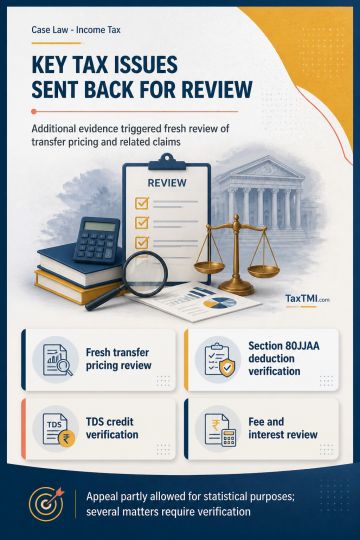
Additional evidence in transfer pricing dispute leads to fresh examination, while tax deductions, TDS credit, fee and refund interest require verifica...
Page of 4819
Press 'Enter' after typing page number.
1561 to 1580 of 96363 Results
❮
❯
❯❯
0 / 200
Expand Note
Add to Folder
No Folders have been created
+
Are you sure you want to delete "My most important" ?
Penalty u/s 271 (1) (c) - Income disclosed only after the search and seizure operation - The High Court emphasized that Explanation 5A of Section 271(1)(c) deems concealed income even if disclosed post-search, and upheld the assessing officer’s initiation of penalty proceedings based on detailed findings of concealed income in the assessment orders. The Court referenced key Supreme Court judgments, asserting that the satisfaction for penalty can be inferred from the assessment order and need not be explicitly stated in the notice if the order details the concealment. It also rejected the respondent’s defense of voluntary disclosure, noting it was made only after irrefutable evidence of concealment emerged during the search. It set aside the ITAT’s order, reinstated the penalties, and remanded the matter to the ITAT for adjudication on merits.
Penalty u/s 271 (1) (c) - Income disclosed only after the search and seizure operation - The High Court emphasized that Explanation 5A of Section 271(1)(c) deems concealed income even if disclosed post-search, and upheld the assessing officer’s initiation of penalty proceedings based on detailed findings of concealed income in the assessment orders. The Court referenced key Supreme Court judgments, asserting that the satisfaction for penalty can be inferred from the assessment order and need not be explicitly stated in the notice if the order details the concealment. It also rejected the respondent’s defense of voluntary disclosure, noting it was made only after irrefutable evidence of concealment emerged during the search. It set aside the ITAT’s order, reinstated the penalties, and remanded the matter to the ITAT for adjudication on merits.
Note: It is a system-generated summary and is for quick reference only.
 TaxTMI
  TaxTMI
 of 4819





















 Join Channel