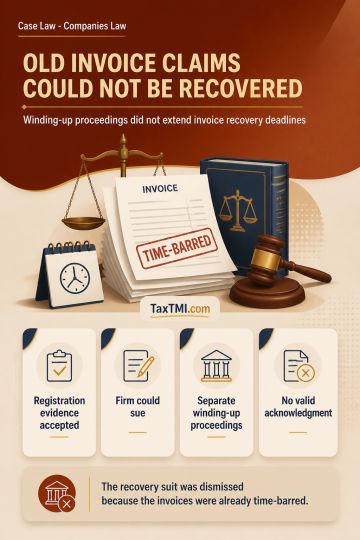
Invoice-based recovery claims remain time-barred despite separate winding-up proceedings, absent valid acknowledgment or part-payment of the disputed ...
Extended limitation fails without specific suppression allegations, while overseas employee secondment remains taxable as manpower supply within norma...
Time-share accommodation classification excludes Club or Association Service where purchasers receive contractual occupancy rights without genuine mem...
CENVAT credit for trading requires reversal, while taxable-service rental credit remains proportionately available and limitation issues await resolut...
Vicarious liability for dishonoured company cheques may extend to non-signatory directors where complaints contain foundational responsibility avermen...
Penalty u/s 271 (1) (c) - Income disclosed only after the search and seizure operation - The High Court emphasized that Explanation 5A of Section 271(1)(c) deems concealed income even if disclosed post-search, and upheld the assessing officer’s initiation of penalty proceedings based on detailed findings of concealed income in the assessment orders. The Court referenced key Supreme Court judgments, asserting that the satisfaction for penalty can be inferred from the assessment order and need not be explicitly stated in the notice if the order details the concealment. It also rejected the respondent’s defense of voluntary disclosure, noting it was made only after irrefutable evidence of concealment emerged during the search. It set aside the ITAT’s order, reinstated the penalties, and remanded the matter to the ITAT for adjudication on merits.
Penalty u/s 271 (1) (c) - Income disclosed only after the search and seizure operation - The High Court emphasized that Explanation 5A of Section 271(1)(c) deems concealed income even if disclosed post-search, and upheld the assessing officer’s initiation of penalty proceedings based on detailed findings of concealed income in the assessment orders. The Court referenced key Supreme Court judgments, asserting that the satisfaction for penalty can be inferred from the assessment order and need not be explicitly stated in the notice if the order details the concealment. It also rejected the respondent’s defense of voluntary disclosure, noting it was made only after irrefutable evidence of concealment emerged during the search. It set aside the ITAT’s order, reinstated the penalties, and remanded the matter to the ITAT for adjudication on merits.
Note: It is a system-generated summary and is for quick reference only.
 TaxTMI
  TaxTMI
 of 4811



















 Join Channel