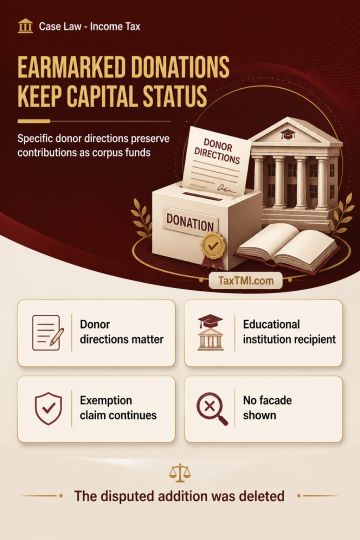
Donor-directed corpus contributions retain capital character despite exemption claims under section 10(23C)(vi), preventing their treatment as taxable...
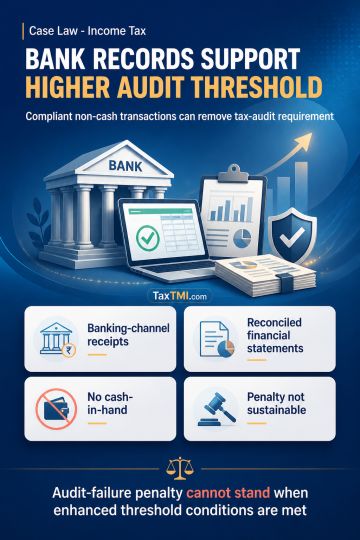
Enhanced tax-audit threshold applies where banking records establish compliant non-cash receipts and payments, eliminating penalty exposure for audit ...
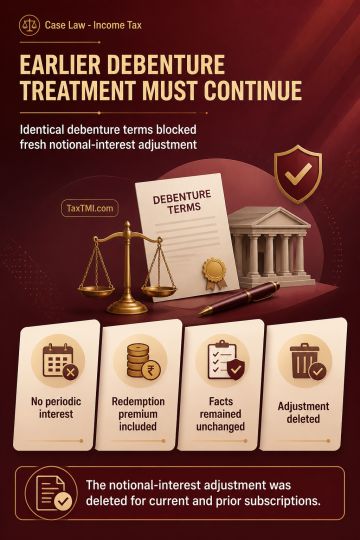
Transfer pricing consistency protects identical non-interest-bearing debenture terms from a later notional-interest adjustment without valid statutory...
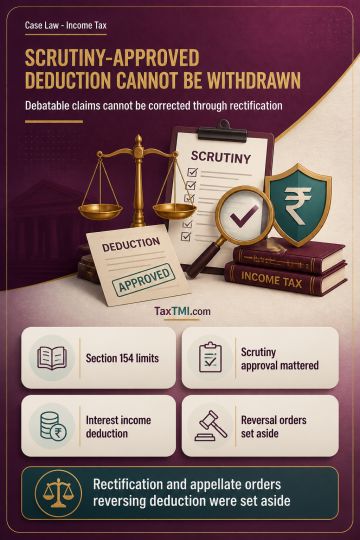
Rectification of debatable deduction claims cannot reverse scrutiny-approved co-operative society interest income deductions as apparent record errors...
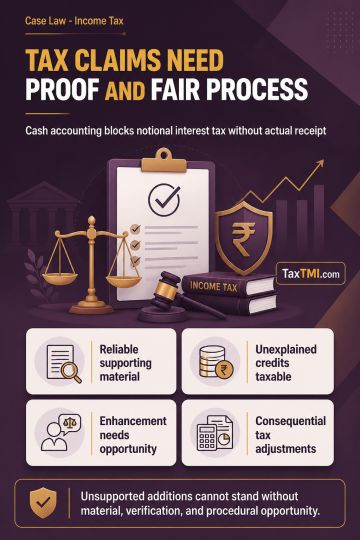
Cash-method accounting bars presumptive interest taxation, while unsupported securities and share-trading additions require reliable material and veri...
Page of 4814
Press 'Enter' after typing page number.
181 to 200 of 96262 Results
❮
❯
❯❯
0 / 200
Expand Note
Add to Folder
No Folders have been created
+
Are you sure you want to delete "My most important" ?
Faceless Assessment - Non affording a reasonable opportunity to be heard through video conferencing - The court referred to Section 144B(6)(vii) and (viii) of the Income Tax Act, which mandates that where a request for a personal hearing is made, it must be provided, and the hearing shall be conducted through video conferencing. The court noted that since the petitioner had requested a video conferencing hearing, it was mandatory for the respondent to accede to the request. The court emphasized the importance of affording the assessee a reasonable opportunity of being heard before passing an adverse order, citing it as a fundamental principle of natural justice. - Consequently, the court set aside the assessment order and remanded the matter to the concerned Assessing Officer for reconsideration.
Faceless Assessment - Non affording a reasonable opportunity to be heard through video conferencing - The court referred to Section 144B(6)(vii) and (viii) of the Income Tax Act, which mandates that where a request for a personal hearing is made, it must be provided, and the hearing shall be conducted through video conferencing. The court noted that since the petitioner had requested a video conferencing hearing, it was mandatory for the respondent to accede to the request. The court emphasized the importance of affording the assessee a reasonable opportunity of being heard before passing an adverse order, citing it as a fundamental principle of natural justice. - Consequently, the court set aside the assessment order and remanded the matter to the concerned Assessing Officer for reconsideration.
Note: It is a system-generated summary and is for quick reference only.
 TaxTMI
  TaxTMI
 of 4814






 Join Channel