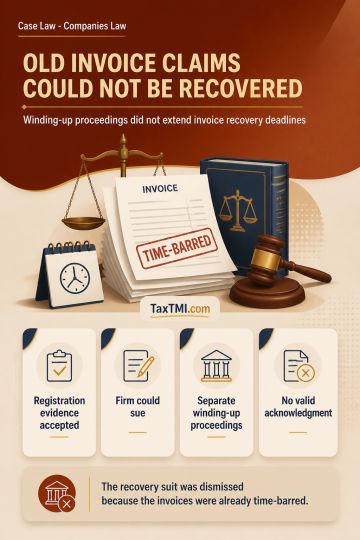
Invoice-based recovery claims remain time-barred despite separate winding-up proceedings, absent valid acknowledgment or part-payment of the disputed ...
Extended limitation fails without specific suppression allegations, while overseas employee secondment remains taxable as manpower supply within norma...
Time-share accommodation classification excludes Club or Association Service where purchasers receive contractual occupancy rights without genuine mem...
CENVAT credit for trading requires reversal, while taxable-service rental credit remains proportionately available and limitation issues await resolut...
Page of 4817
Press 'Enter' after typing page number.
561 to 580 of 96333 Results
❮
❯
❯❯
0 / 200
Expand Note
Add to Folder
No Folders have been created
+
Are you sure you want to delete "My most important" ?
Validity of order passed u/s 147 r.w.s.144B - availability of alternate statutory remedy - The High Court recognized that the arguments presented could be considered by examining the record. However, the Court refrained from conducting a fishing inquiry into the case under its writ jurisdiction due to factual complexities. - The High Court referred to Supreme Court decisions emphasizing the importance of exhausting statutory remedies before approaching the court under Article 226 of the Constitution. It held that when an alternate remedy is available, judicial prudence dictates refraining from exercising jurisdiction under constitutional provisions. Therefore, the High Court dismissed the writ petition, directing the petitioner to avail themselves of the statutory remedy of appeal.
Validity of order passed u/s 147 r.w.s.144B - availability of alternate statutory remedy - The High Court recognized that the arguments presented could be considered by examining the record. However, the Court refrained from conducting a fishing inquiry into the case under its writ jurisdiction due to factual complexities. - The High Court referred to Supreme Court decisions emphasizing the importance of exhausting statutory remedies before approaching the court under Article 226 of the Constitution. It held that when an alternate remedy is available, judicial prudence dictates refraining from exercising jurisdiction under constitutional provisions. Therefore, the High Court dismissed the writ petition, directing the petitioner to avail themselves of the statutory remedy of appeal.
Note: It is a system-generated summary and is for quick reference only.
 TaxTMI
  TaxTMI
 of 4817















 Join Channel


