Charitable trust income application permits verified capital expenditure but rejects deferred pre-operative claims and requires reconsideration of con...
Reinsurance premium deductions require established regulatory breaches, while independently acquired software qualifies within the computer depreciati...
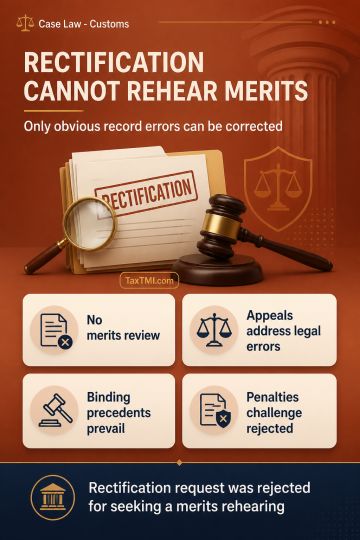
Rectification of mistake remains limited to self-evident record errors, preventing merits review through miscellaneous applications and preserving fin...
Tender creditworthiness conditions may extend to de facto Promoter Directors, with post-participation challenges generally barred absent arbitrariness...
Corporate representation in PMLA summons proceedings permitted through an authorised signatory, subject to directors' continuing cooperation and atten...
Legality of Not Extending Anti-dumping duty - Power of Central Government to accept or reject the recommendations of the Designated Authority (DA) - Imports of the Textured Toughened (Tempered) Glass of Chinese origin - The High court held that the Central Government has the legislative discretion to accept or reject the recommendations of the DA. This decision is guided by broader economic considerations and public interest, rather than strictly adhering to the DA's findings. - It was clarified that the imposition or non-imposition of anti-dumping duty is a legislative decision, and the government is not required to provide a detailed reasoned order. - The court reiterated that its role is limited in matters of economic policy and legislative discretion exercised by the government. The judicial review does not extend to questioning the wisdom or advisability of such economic decisions unless there is a clear violation of statutory provisions or principles of natural justice.
Legality of Not Extending Anti-dumping duty - Power of Central Government to accept or reject the recommendations of the Designated Authority (DA) - Imports of the Textured Toughened (Tempered) Glass of Chinese origin - The High court held that the Central Government has the legislative discretion to accept or reject the recommendations of the DA. This decision is guided by broader economic considerations and public interest, rather than strictly adhering to the DA's findings. - It was clarified that the imposition or non-imposition of anti-dumping duty is a legislative decision, and the government is not required to provide a detailed reasoned order. - The court reiterated that its role is limited in matters of economic policy and legislative discretion exercised by the government. The judicial review does not extend to questioning the wisdom or advisability of such economic decisions unless there is a clear violation of statutory provisions or principles of natural justice.
Note: It is a system-generated summary and is for quick reference only.
 TaxTMI
 of 4805


















 Join Channel


 TaxTMI
