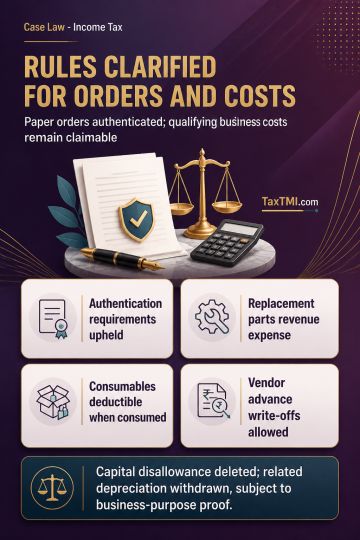
Authentication of paper assessment orders upheld, while qualifying repairs, consumables and vendor advance write-offs remain deductible business claim...
Transaction value cannot be rejected solely on non-statutory valuation guidelines without corroborative evidence supporting reassessment of final cust...
Cross-examination rights and corroborated evidence limit customs penalties for misdeclaration in genuine import transactions involving documented clea...
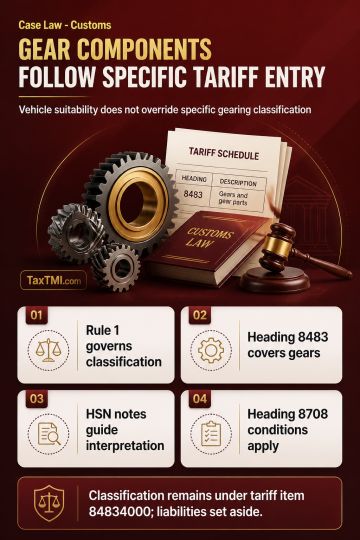
Tariff classification of vehicle gear components follows the specific gearing entry, displacing motor-vehicle parts classification and related liabili...
Necessary-party requirements limit impleadment of independent entities, while deferred consideration does not create an appealable adverse determinati...
Interest Liability on Electronic Credit Ledger Payments - Seeking levy of interest only on that part of the tax which is paid in cash - The High court concluded that the levy of interest depends not on the type of ledger used (cash or credit) but on the timing of the tax payment relative to the filing of returns. Interest is applicable on delays in tax payments made after the due date of return filing, regardless of whether the payment is from the Electronic Credit Ledger or the Cash Ledger. The court found that while the Monitoring Committee can issue guidelines, its decisions are not binding on the Proper Officer in the context of tax recovery. The Proper Officer retains autonomy in assessing and executing recovery based on individual case assessments.
Interest Liability on Electronic Credit Ledger Payments - Seeking levy of interest only on that part of the tax which is paid in cash - The High court concluded that the levy of interest depends not on the type of ledger used (cash or credit) but on the timing of the tax payment relative to the filing of returns. Interest is applicable on delays in tax payments made after the due date of return filing, regardless of whether the payment is from the Electronic Credit Ledger or the Cash Ledger. The court found that while the Monitoring Committee can issue guidelines, its decisions are not binding on the Proper Officer in the context of tax recovery. The Proper Officer retains autonomy in assessing and executing recovery based on individual case assessments.
Note: It is a system-generated summary and is for quick reference only.
 TaxTMI
 of 4803




















 Join Channel


 TaxTMI
