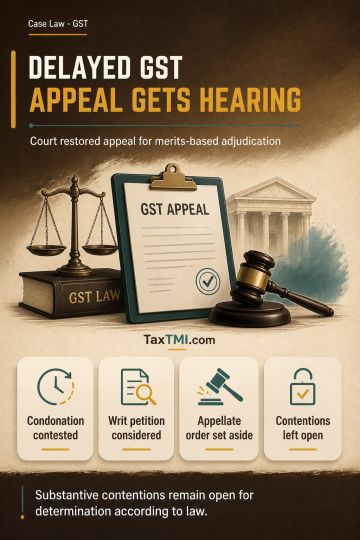
Necessary-party requirements limit impleadment of independent entities, while deferred consideration does not create an appealable adverse determinati...
Food supplement classification requires common parlance and authoritative tests, preventing treatment as proprietary Ayurvedic medicines without suppo...
Specified regulatory authority income receives conditional tax exemption, subject to non-commercial activity, unchanged income character, and return f...
Tax exemption for regulatory authority income applies retrospectively, subject to non-commercial activity, unchanged income sources, and return-filing...
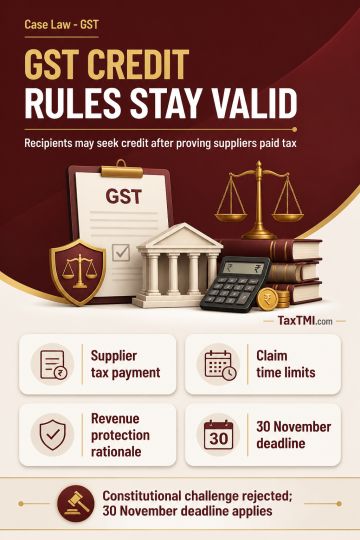
Input tax credit conditions remain constitutionally valid, with eligible recipient claims considered under GST circulars and retrospective filing dead...
Dishonour of Cheque - insufficient funds - discharge of legal liability - A scenarios involving financial transactions with potentially fraudulent undertones - The High court noted that this presumption is rebuttable and that the defense had successfully cast doubt on the existence of the alleged debt. - Significant to this case was the finding on the financial capacity of the petitioner. Evidence and circumstances suggested that the petitioner’s financial status was inconsistent with the ability to lend the amounts claimed. - The High Court upheld the appellate court’s decision to acquit the accused, emphasizing the lack of concrete evidence on the petitioner's ability to lend such an amount and the improbability of the debt’s existence.
Dishonour of Cheque - insufficient funds - discharge of legal liability - A scenarios involving financial transactions with potentially fraudulent undertones - The High court noted that this presumption is rebuttable and that the defense had successfully cast doubt on the existence of the alleged debt. - Significant to this case was the finding on the financial capacity of the petitioner. Evidence and circumstances suggested that the petitioner’s financial status was inconsistent with the ability to lend the amounts claimed. - The High Court upheld the appellate court’s decision to acquit the accused, emphasizing the lack of concrete evidence on the petitioner's ability to lend such an amount and the improbability of the debt’s existence.
Note: It is a system-generated summary and is for quick reference only.
 TaxTMI
 of 4792



















 Join Channel


 TaxTMI