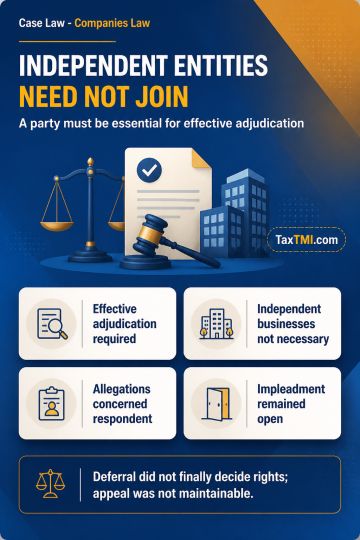
Necessary-party requirements limit impleadment of independent entities, while deferred consideration does not create an appealable adverse determinati...
Food supplement classification requires common parlance and authoritative tests, preventing treatment as proprietary Ayurvedic medicines without suppo...
Specified regulatory authority income receives conditional tax exemption, subject to non-commercial activity, unchanged income character, and return f...
Tax exemption for regulatory authority income applies retrospectively, subject to non-commercial activity, unchanged income sources, and return-filing...
Input tax credit conditions remain constitutionally valid, with eligible recipient claims considered under GST circulars and retrospective filing dead...
Levy of Penalty u/s 112 (a) and (b) and 114AA of the Customs Act, 1962 - Abetment in mis-declaration of goods and evasion of duty - The appellants were accused of being involved in a scheme using dummy Import Export Codes (IECs) - The tribunal confirmed that three shipments declared as sunglasses or packing materials were actually high-value branded garments. This misdeclaration led to significant undervaluation, affecting the customs duty applicable. - One appellant was documented to have coordinated the logistics of the misdeclared imports, including providing details to customs agents. This was established through corroborated statements and WhatsApp messages, which showed coordination with a known associate and various import/export details being shared for clearing the misdeclared goods. - The tribunal upheld the penalties based on the appellants’ involvement in the misdeclaration and undervaluation of imported goods, which resulted in substantial customs duty evasion.
Levy of Penalty u/s 112 (a) and (b) and 114AA of the Customs Act, 1962 - Abetment in mis-declaration of goods and evasion of duty - The appellants were accused of being involved in a scheme using dummy Import Export Codes (IECs) - The tribunal confirmed that three shipments declared as sunglasses or packing materials were actually high-value branded garments. This misdeclaration led to significant undervaluation, affecting the customs duty applicable. - One appellant was documented to have coordinated the logistics of the misdeclared imports, including providing details to customs agents. This was established through corroborated statements and WhatsApp messages, which showed coordination with a known associate and various import/export details being shared for clearing the misdeclared goods. - The tribunal upheld the penalties based on the appellants’ involvement in the misdeclaration and undervaluation of imported goods, which resulted in substantial customs duty evasion.
Note: It is a system-generated summary and is for quick reference only.
 TaxTMI
 of 4792

















 Join Channel


 TaxTMI

