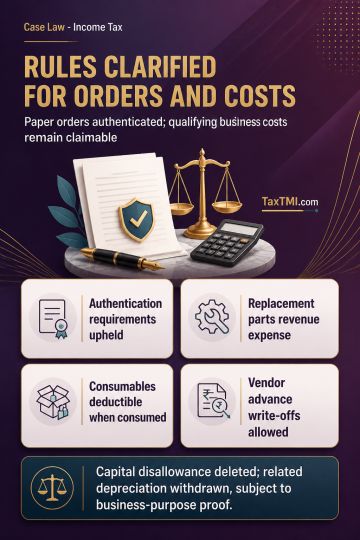
Authentication of paper assessment orders upheld, while qualifying repairs, consumables and vendor advance write-offs remain deductible business claim...
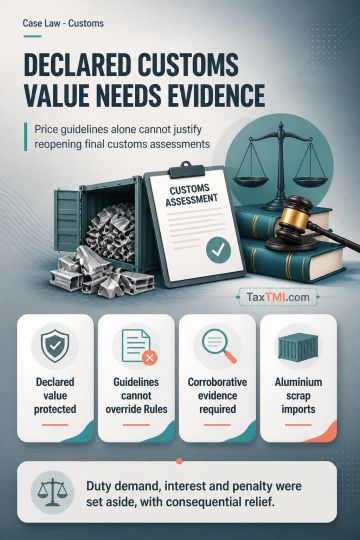
Transaction value cannot be rejected solely on non-statutory valuation guidelines without corroborative evidence supporting reassessment of final cust...
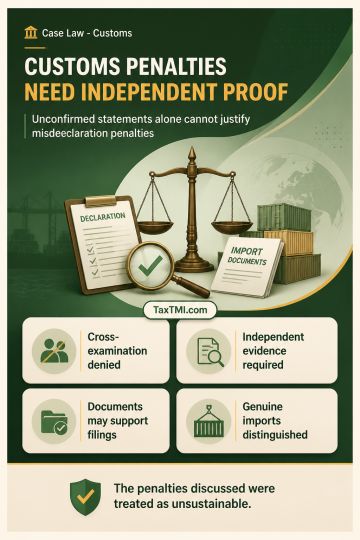
Cross-examination rights and corroborated evidence limit customs penalties for misdeclaration in genuine import transactions involving documented clea...
Page of 4782
Press 'Enter' after typing page number.
301 to 320 of 95636 Results
❮
❯
❯❯
0 / 200
Expand Note
Add to Folder
No Folders have been created
+
Are you sure you want to delete "My most important" ?
Levy of penalty @200% - e-way bill which was generated by the appellant had expired and at the time when the vehicle was intercepted four days had lapsed - The High Court acknowledged that penalties should not be imposed without considering mens rea. While the statute allows for a penalty of 200%, it does not absolve authorities from considering circumstances and intentions. Despite the expiration of the e-way bill, the Court found that the appellant's failure to extend the validity was a crucial factor. However, it noted that the penalty was calculated on a higher value than the invoice, indicating arbitrariness on the part of the authorities. Ultimately, the Court partially allowed the appeal, imposing a reduced penalty but refrained from completely exonerating the appellant.
Levy of penalty @200% - e-way bill which was generated by the appellant had expired and at the time when the vehicle was intercepted four days had lapsed - The High Court acknowledged that penalties should not be imposed without considering mens rea. While the statute allows for a penalty of 200%, it does not absolve authorities from considering circumstances and intentions. Despite the expiration of the e-way bill, the Court found that the appellant's failure to extend the validity was a crucial factor. However, it noted that the penalty was calculated on a higher value than the invoice, indicating arbitrariness on the part of the authorities. Ultimately, the Court partially allowed the appeal, imposing a reduced penalty but refrained from completely exonerating the appellant.
Note: It is a system-generated summary and is for quick reference only.
 TaxTMI
 of 4782






 Join Channel


 TaxTMI